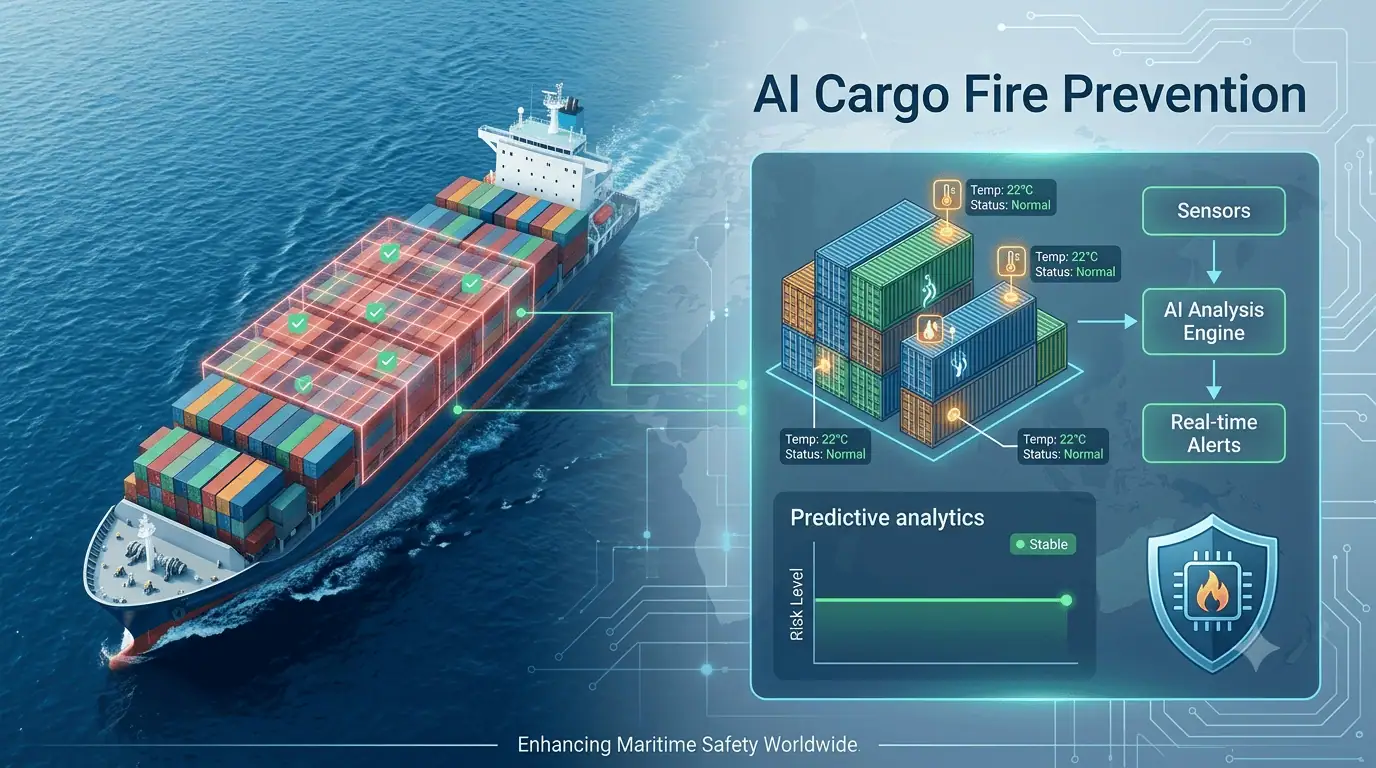
The global shipping industry forms the centre of international trade. Maritime shipping carries 80% of global trade, yet faces a growing safety crisis, particularly from increasingly frequent ship fires.
Allianz’s 2025 review found ship fires led maritime incidents over the decade, driven largely by misdeclared dangerous cargo.
Shippers misdeclare cargo to cut freight costs and bypass stricter regulations, increasing the risk of dangerous incidents at sea.
AI technologies like machine learning, pattern recognition, and real-time analytics are helping prevent cargo fires caused by misdeclared shipments.
This blog explores how AI reduces cargo fire risks and strengthens ship safety through real-world examples of emerging maritime technologies.
Why Are Cargo Fires Increasing on Ships?
AI’s role can be better understood in the context of the reasons driving a broader surge in fire incidents. Firstly, global container volumes are increasing rapidly, which has added to cargo complexity like never before. Lithium-ion battery ship fires have become particularly prevalent as EV cargo volumes increase on car carriers worldwide.
As regulations tighten, shippers have turned to misdeclaring dangerous goods to avoid paying surcharge fees.
Traditional fire detection systems have become redundant, which further amplifies the intensity of fire within sealed cargoes. Routine maintenance can miss equipment degradation, allowing hidden faults to trigger electrical fires in engine rooms and machinery spaces.
1. AI-Powered Fire Detection Systems for Ships: How They Work
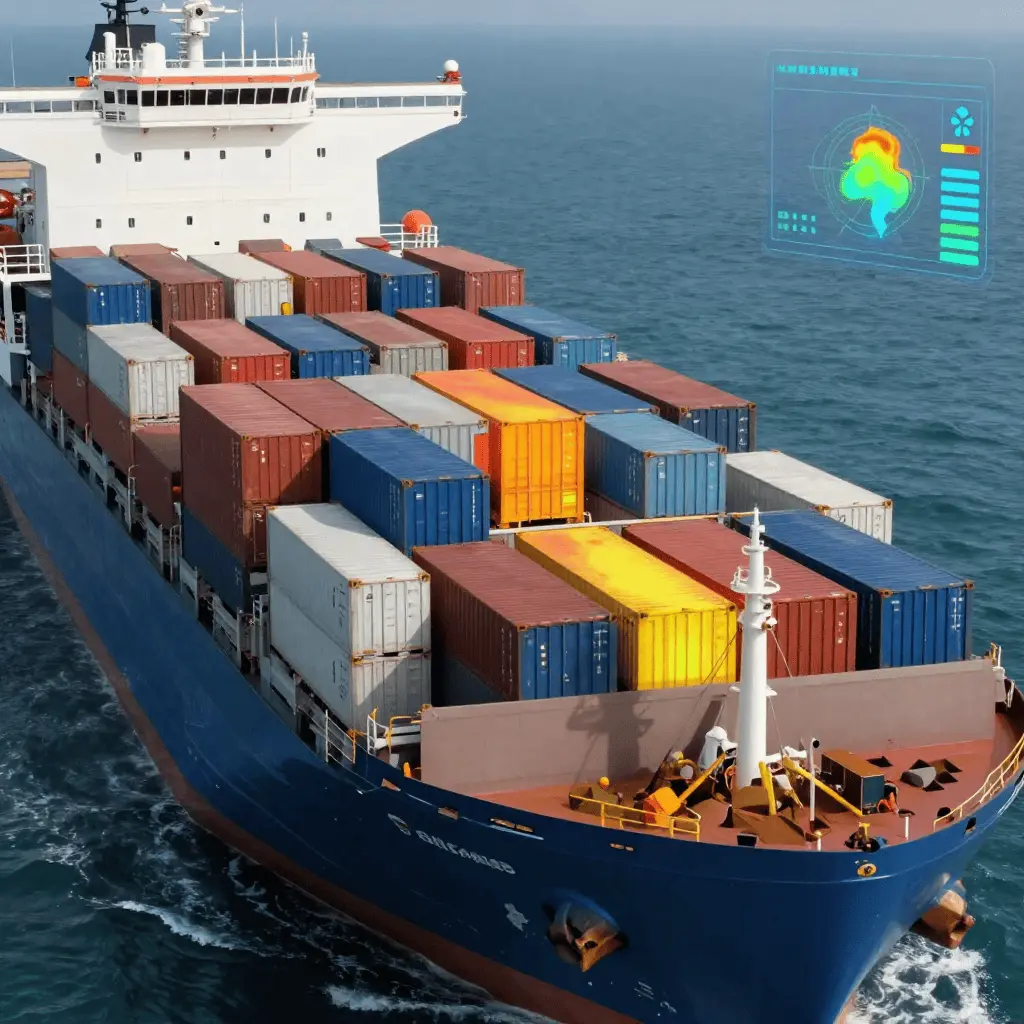
Traditional detectors often respond only after smoke or gas appears, potentially delaying fire detection or failing to detect fires. AI monitoring continuously analyzes cameras, temperatures, and sensors to detect fire risks early and prevent ignition conditions.
A prominent example is Mitsui O.S.K. MOL uses AI-powered cameras and machine learning on LNG car carriers to continuously monitor footage and detect potential fire risks. These AI models detect early smoke, heat, and ember patterns, identifying potential fire threats before they develop into serious incidents. In case of an anomaly, the system notifies the vessel crew and the onshore management team to respond accordingly.
AI distinguishes real fire hazards from harmless steam or heat, reducing false alarms and helping crews respond quickly to genuine threats.
2. AI Cargo Screening: How Misdeclared Dangerous Goods Are Caught Before Loading
Arguably, the biggest way to prevent a fire is to stop dangerous cargo from entering the ship. A landmark industry initiative, the World Shipping Council’s Cargo Safety Program illustrates how AI-driven cargo screening can help detect undeclared or misdeclared dangerous goods among millions of container bookings in real time.
More than 70% of global carriers enlisted in the program after its launch, a positive signal that AI-assisted risk assessment has attracted widespread buy-in in the industry, not merely as a competitive differentiator but a core part of shipping infrastructure.
AI analyzes booking data, HS codes, trade patterns, and shipper histories to identify high-risk shipments for targeted physical inspections. Moreover, it learns from past incidents to improve detection accuracy and thus preparedness in the face of future risks
AI tackles fire risks at the source by identifying misdeclared dangerous cargo, reducing the likelihood of onboard fires.
3. Real-Time AI Hazard Monitoring for Maritime Safety
In the course of their journeys, ships face uncertain conditions, which makes continuous surveillance a strategic requirement to trace the cargo on board. AI systems come equipped with real-time analytics that help to monitor the movement of containers from their origin to their destination together with temperature fluctuations and sensor outputs, to identify impending hazards early on.
A distinctive feature of AI is Anomaly detection, which detects any subtle deviations from normal patterns. For instance, a smoldering fire or a chemical reaction can cause a sudden local heat spike. AI combines infrared, thermal, vibration, and gas data to identify high-risk conditions that conventional monitoring may overlook.
AI real-time monitoring closes the gap between hazard detection and crew awareness, enabling faster action to contain emerging risks. Kongsberg Maritime vessel monitoring systems represent these systems in action by integrating data streams from infrared cameras, thermal sensors, and vibration monitors into centralized dashboards. These dashboards help raise situational awareness to flag anomalies and alert officers in time before they become full-blown emergencies.
4. AI Predictive Maintenance: Preventing Engine Room Fires at Sea
Cargo is not the only fire risk aboard the vessel: critical ship systems like engine room fires, electrical system failures, and overheating mechanical components make up a major portion of maritime incidents. Traditional maintenance schedules work around fixed schedules that react to breakdowns instead of addressing existing conditions.
AI-driven predictive maintenance replaces periodic maintenance scheduling with proactive intervention. Sensors are embedded throughout the ship, from engines and pumps to generators, wiring systems, and power units that generate continuous performance data for machine learning models to identify which components are likely to malfunction. For example, Wärtsilä’s Voyage Solutions platform uses AI to monitor propulsion systems and recommend predictive maintenance strategies in real time.
In practical terms, a chief engineer is alerted to a specific pump bearing that is vibrating in its early-stage failure before it could overheat and potentially spark an engine room fire. He may then schedule a port call to get the faulty bearing replaced rather than get caught in an emergency at sea.
AI models draw upon historical data, performance trends, and temperature variances to lower unexpected downtime while extending the lifespan of machinery. By reducing mechanical surprises, predictive maintenance promotes safety-oriented maritime operations.
5. How AI Training Simulators Improve Crew Fire Response
AI technologies aren’t advanced enough as yet to guarantee foolproof protection. That’s where human discretion and decision-making play an integral role in responding appropriately to maritime incidents. Advanced training and simulation tools rely on a synergy of humans and AI to enhance the ability of crews to address wide-ranging emergency scenarios.
Real-life emergencies are far too complex to be reduced to specific scenarios. There is always the chance that fire can spread uncontrollably, while equipment failures and communication breakdowns can hinder response. Platforms such as VSTEP’s NAUTIS simulator and Kongsberg Digital’s training systems utilize AI to generate dynamic, data-driven emergency scenarios that can be tailored to trainee decisions in real-time.
Assuming a crew member makes an incorrect call early in a simulated fire response, AI can follow up with a scenario depicting what the consequences might be. This foresight makes shippers well-equipped to handle complex situations rather than preparing for specific use cases.
Unlike traditional drills, AI training systems expose crews to rare as well as catastrophic situations like hold fires in heavy weather or simultaneous engine room and cargo deck emergencies. Tapping into performance analytics can highlight major gaps in decision-making or response timing to tailor learning paths according to each trainee’s performance.
What Are the Current Limitations of AI in Maritime Safety?
Notwithstanding the transformative role in maritime safety, it’s important to appreciate its limits. Data quality remains a significant constraint. AI models are only as accurate as the data they are trained on, while maritime incident data is known to be historically inconsistent and difficult to standardize across international jurisdictions. When trained on incomplete incident histories, AI may miss risk patterns that haven’t yet been formally documented.
Secondly, substantial capital is required to upgrade existing infrastructure to support AI monitoring systems, which can be difficult for smaller operators and aging fleets.
Regulatory frameworks have also not kept pace with the technology. There remains an uncertainty as to what standards and compliance requirements can apply to AI-assisted safety systems across borders that hinders adoption. (MSC). The IMO has developed the MASS Code, which is a regulatory framework to evaluate and certify the use of AI-assisted safety systems on vessels with conventional crews.
Given these limitations, it is far too early to consider AI a stand-alone solution. Its current potential consists of providing a robust layer within a broader safety system that should work in tandem with human oversight and regulatory compliance to tackle safety challenges across operations.
Conclusion
Cargo fires are no longer an inevitable part of maritime trade. AI is paving the way for a resilient shipping ecosystem that goes beyond reactive responses to anticipate and mitigate risks that can potentially lead to ship fires.
As AI reshapes maritime safety from cargo screening to predictive maintenance, the real winners are harnessing the potential of digitization and integration to improve operational efficiency and bolster maritime safety. ShipSearch offers an intuitive, intelligent platform that brings together cargo opportunities, vessel charters, and ship transactions to empower maritime professionals.
Start free and upgrade when you’re ready. Join ShipSearch Today.
Frequently Asked Questions About AI and Ship Safety
How does AI detect cargo fires on ships?
AI fire detection systems combine real-time analytics and predictive maintenance capabilities to analyze real-time data drawn from cameras and sensors, to gauge the probability of fire incidents. It tracks smoke and localized heat spikes to flag high-risk cargoes before loading to prevent fire incidents from occurring.
What is misdeclared cargo, and why is it a fire risk?
Misdeclared cargo carries shipments that are intentionally misdocumented or come with inaccurate information regarding their content. Such cargoes violate the International Maritime Dangerous Goods (IMDG) codes by not declaring the presence of hazardous goods, such as Lithium-ion batteries and flammable liquids, in cargoes to circumvent surcharges or regulatory requirements. These goods can cause spontaneous combustion or severe explosions when they enter cargo.
What is the MASS Code and how does it affect AI maritime safety systems?
The MASS refers to the legal framework developed at the behest of IMO that sets guidelines for testing and approval of AI and autonomous safety systems on ships. Its purpose is to regulate the use of AI on vessels to ensure safer operations with minimum risks.
Can AI replace human crew members in fire response?
AI systems function to augment human capabilities rather than replace them by getting rid of manual processes and bringing certainty into how safety hazards are managed. AI features, such as early detection, real-time monitoring, and predictive maintenance, provide critical insights into the safety of cargo that can prevent accidental ship fires.