If you’ve spent any time in maritime logistics, you should have probably come across the terms “marine traffic” vs “vessel tracking” as if they are one and teh same thing. In reality, they refer to two distinct tracking methods that lie at the heart of tracking modern shipping operations.
Remarkably, 90% of everything you buy originated on a ship, and the global maritime industry carries a staggering 11 billion tons of cargo each year. However, maritime professionals have to contend with an increasingly uncertain environment, and that’s where data can make all the difference.
Navigating in today’s marine environment rests on understanding the difference between two data concepts that shape modern maritime operations: marine traffic monitoring and vessel tracking.
This guide breaks down exactly how they differ, what data each relies on, and which one you actually need for your operations.
What Is Marine Traffic?
Marine traffic is a term that collectively refers to the entire range of vessels traversing global waterways, from tankers, naval ships, container ships, to shipping boats, yachts, and passenger ships.
Marine traffic monitoring relies on advanced tracking systems to determine the movement of ships and vessels across seas to ensure their safety and efficiency.
It’s a broad term that encompasses tracking not only a ship’s position at a given point in time, but the specific shipping lanes it passes through, the level of marine congestion encountered in the way, and port activity.
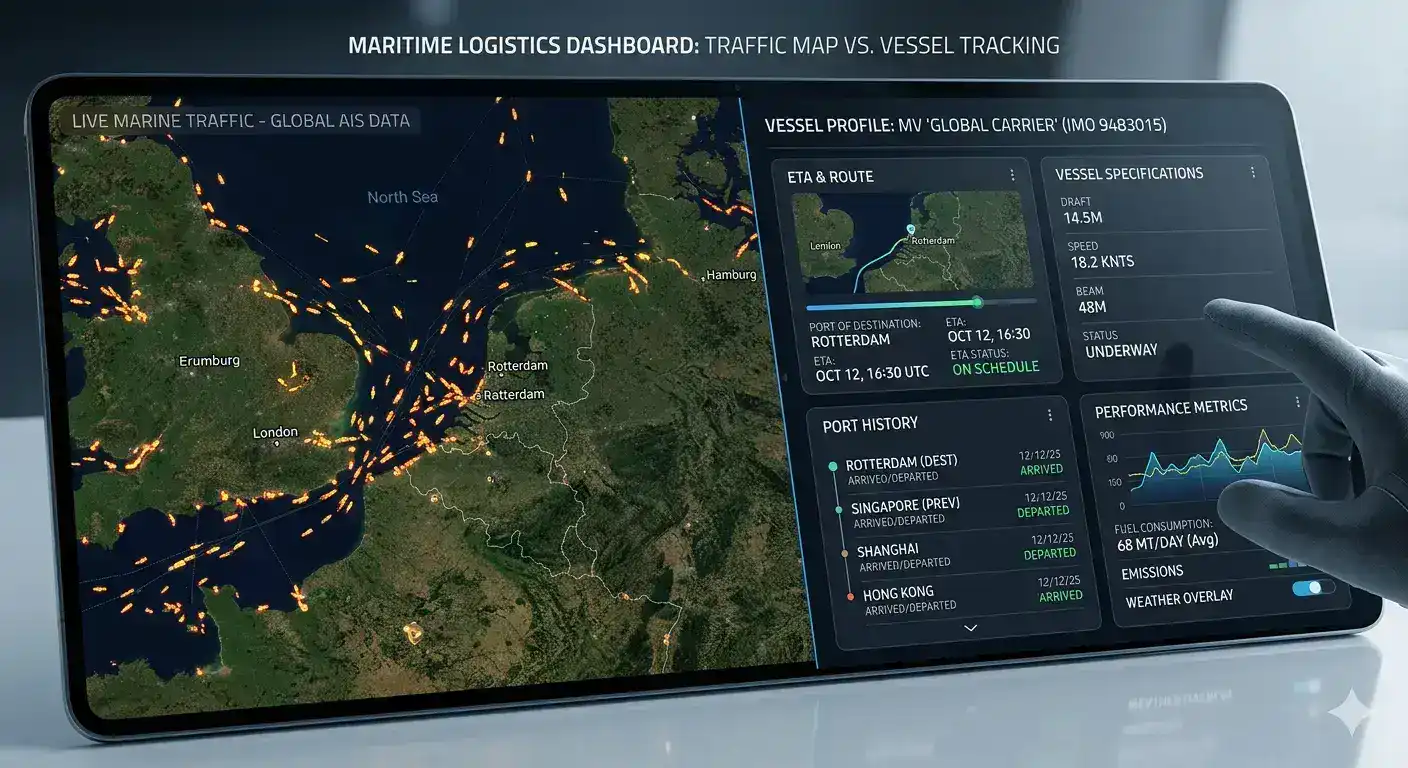
Generally, ships are equipped with AIS transmitters that relay critical data to coastal AIS receivers and satellites. The data helps maritime professionals assess the type of cargo being carried and the vessel’s dimensions, the latitude and the longitude of a ship’s current position, as well as the destination and estimated time of arrival (ETA).
This information is processed in real time to generate an interactive map that represents ships moving in real-time. The map can be accessed online or via marine traffic apps that give crucial insights into multiple aspects of global shipping activity, including
- vessel locations
- speed and direction
- nearby ships
- port arrivals and departures
What is Vessel Tracking?
Marine Traffic offers the “big picture” of global movement. In contrast, Vessel Tracking zooms in on a particular vessel in the course of its journey at sea. It is driven by a specific goal of monitoring a particular ship or fleet and gathering precise logistics intelligence such as real-time positions and basic vessel details.
Vessel tracking is specially used by maritime professionals and charterers to harness data to manage high-value cargo and time-sensitive fleet.
In the modern maritime industry, vessel tracking is no longer just about connecting dots on a map; it is a sophisticated data service to track a ship every step of the way to manage supply chains, ensure security, and optimize fuel efficiency.
How Vessel Tracking Works
Vessel tracking relies on a multi-layered data network to “track” a ship’s journey, from its point of departure till it arrives at its intended destination.
Terrestrial AIS: Ships located within a range of about 20–40 nautical miles transmit high-frequency signals to AIS base stations. An AIS system integrated into a vessel exchanges information about the current position and timing of a ship with external AIS transceivers fitted on other ships or land-based systems, such as VTA systems.
This helps to determine how far a ship is from the port, as well as how congested the coastal lanes are, to track a ship’s progress.
Satellite AIS (S-AIS): Once a ship crosses into open ocean and moves beyond the range of terrestrial networks, satellites orbiting in low Earth orbit (LEO) take over, capturing VHF transmissions from vessels anywhere on the globe. This ensures continuous surveillance even thousands of miles from the nearest coast.
Inmarsat & Cospas-Sarsat: For high-security or high-value assets, proprietary satellite tracking (beyond open AIS) provides encrypted positioning data used by fleet managers.
The Data Vessel Tracking Captures
Every AIS transmission carries structured data across three categories. Static data includes the vessel name, IMO number, MMSI, call sign, vessel type, and dimensions.
Dynamic data covers real-time latitude and longitude, speed over ground, course, heading, and navigational status.
Voyage data includes the destination port, ETA, draft, and route intentions. It’s worth noting that voyage data is often entered manually by crew, making it susceptible to human error.
Marine Traffic vs Vessel Tracking: Key Differences
| Feature | Marine Traffic (The Environment) | Vessel Tracking (The Action) |
| Scope | Global monitors all visible ships | Specific; monitors a selected vessel or fleet. |
| Primary Goal | General awareness and traffic safety. | Logistics, ETA precision, and security. |
| User Base | Enthusiasts, port authorities, casual observers. | Charterers, ship owners, and logistics providers. |
| Data Focus | Congestion and shipping lane density. | Route history, fuel efficiency, and cargo status. |
Why Vessel Tracking Matters Strategically
For maritime professionals, a vessel tracking service offers several operational advantages:
Supply Chain Visibility
Freight forwarders and cargo owners track vessels at different stages of transit to anticipate exactly when their containers will hit the dock. Knowing arrival times in advance allows them to coordinate trucks and warehouses in real-timeeducing detention and demurrage exposure.
If you’re exploring how to charter a vessel for a specific cargo movement, our complete chartering guide walks through the full process.
Fleet Management
Ship owners monitor their entire fleet to check for “speed over ground” (SOG). This specific metric uses GPS technology to calculate a vessel’s speed relative to the ground or seabed while accounting for external factors like currents, tides, and wind.
This makes it possible to determine fuel consumption per nautical mile and generate accurate ETAs. For owners active in the buying and selling market, fleet-level tracking data also informs asset valuations and sale timing. Check out our ships for sale listings to gain insights on how vessel condition and trading history factor into pricing.
.
Safety and Search & Rescue (SAR)
Vessel tracking comes in handy if a ship encounters an unforeseen event along its voyage, such as a storm or mechanical breakdown. Access to its last known navigational status and position dramatically expedites SAR coordination. The IMO mandates AIS carriage for this reason, considering how real-time position data can be leveraged to save lives.
Geofencing & Alerts
Modern tracking software allows users to set up “virtual fences” around ports or high-risk zones. When a vessel enters or exits a defined perimeter, automatic alerts notify operators immediately — a critical tool for managing available cargo movements that are time-sensitive or route-specific.
Ready to Take Control of Your Maritime Operations?
Understanding the difference between marine traffic and vessel tracking is the first step — but knowing which vessel is carrying your cargo, where it is right now, and when it will arrive is what actually moves the needle for your business.
That’s exactly what ShipSearch is built for. Whether you’re managing a single shipment or moving tonnes of cargo on a strict deadline, ShipSearch gives you real-time visibility and fleet intelligence all in one platform to streamline your marine operations.
Explore ShipSearch to find, verify, and track your next fixture with high-level precision
Frequently Asked Questions
What is the difference between marine traffic and vessel tracking?
Marine traffic shows global shipping activity, while vessel tracking monitors specific ships or fleets throughout their voyages. It is used primarily by logistics professionals managing cargo and deadlines.
What is AIS, and why does it matter for vessel tracking?
AIS (Automatic Identification System) is the backbone of both marine traffic monitoring and vessel tracking. AIS transponders fitted on ships broadcast a range of ship data, such as ship position, speed, destination, and identity, that is then picked up by coastal receivers and satellites. This makes it possible to track vessels in real time across both coastal and open-ocean routes.
What happens when a vessel moves beyond terrestrial AIS range?
After a ship moves 20–40 nautical miles away from land-based stations, the transmission range stops working for the vessels. Instead, S-AIS comes into play, where satellites in space track vessel movements and then transmit their information back to tracking platforms.
Who uses vessel tracking services?
Vessel tracking is primarily used by those associated with the marine industry, including ship owners, charterers, freight forwarders, port authorities, and cargo owners.
These professionals use data from vessel tracking platforms to locate vessels in real-time, optimize routes, and accurately predict ETA’s.
Is vessel tracking only useful for large commercial fleets?
Not at all. While it is most beneficial for large-scale operators, it is equally useful for operators transporting single high-value vessels or those with time-sensitive charters. Logistics companies can use vessel tracking to monitor fleet movement and ensure just-in-time deliveries to help overcome shipping delays and high operating costs.