
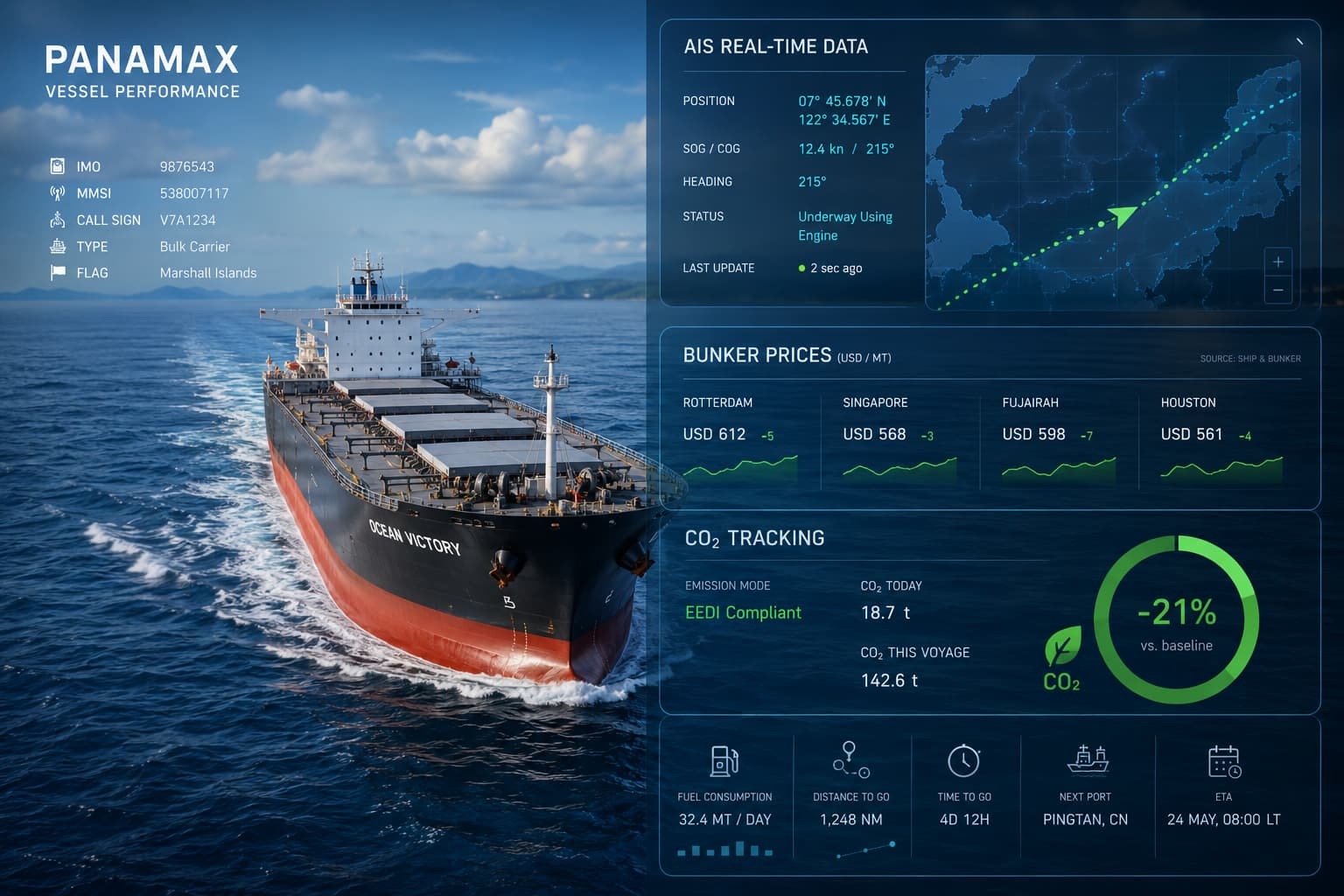
| Voyage cost estimation helps ship brokers forecast a trip’s real profitability before fixing a charter. By accounting for bunkers, port charges, canal dues, laytime, and carbon costs, brokers can reduce surprises and protect margins on every voyage. |
The shipping industry relies heavily on voyage cost estimation to forecast the potential cost and profitability of a sea journey.
Voyage cost estimation is the difference between a charter that looks good on paper and one that sinks your revenue in the sea. For ship brokers and chartering managers, it’s not a formality but a key driver of vessel chartering decisions that can tilt the balance between profit and loss.
The stakes are high. A single miscalculation due to a missed canal toll, a misread port holiday, or a bunker price pulled from last week’s rate, can cost thousands before the vessel even departs.
In a market shaped by volatile fuel prices, EU carbon regulations, and real-time port dynamics, rough estimates are no longer a calculated risk.
In this guide, we dive into the fundamentals of voyage estimation to understand how marine professionals use digital tools to forecast voyage costs, profits, and duration to ensure operational success.
| At a Glance:Primary Goal: To forecast TCE (Time Charter Equivalent) and Net Profit.Key 2026 Variable: Carbon allowances (EU ETS) now represent a significant margin shift.Tool Shift: Moving from static Excel sheets to AIS-integrated Digital Twins. |
What is Voyage Cost Estimation?
Voyage estimation calculates the potential profit a specific voyage can generate before fixing a charter.
Ship brokers and chartering managers typically perform voyage estimation calculations as a decision-making tool to compare different voyages and vessel options. This enables them to pick the one that offers the right balance between costs and revenue.
The fundamental equation is simple:
Net Profit = Gross Revenue – (Voyage Costs + Operating Costs)
However, “Voyage Costs” depend on several external factors, including marine geography, distances between major ports, port expenses, and bunkering facility availability along the route.
6 Ways Brokers Save “Thousands Per Trip.”
1. Eliminating “Dead Time” via Laytime Negotiation
Brokers negotiate laytime for moving freight, which is the time spent in loading/unloading cargo. A reasonable laytime helps reduce the expenses incurred by a charterer for a ship sitting idle by turning it into a daily hire.
The broker may settle for better loading rates or insert “SHINC” (Sundays and Holidays Included) terms in shipping contracts to save additional costs due to lost time.
2. Using Digital Twin Technology & Real-Time Data
Modern brokers have shifted from manual voyage estimation calculation using Excel to AI-driven tools. While spreadsheets are widely accessible and good for basic calculations, they are prone to human error that can potentially lead to inaccurate estimates.
Moreover, shipping conditions are highly dynamic, as fuel prices, weather conditions, and freight rates remain more volatile than steady. AI tools provide real-time data that makes it possible to maintain up-to-date records on shipping data, like fuel prices, freight rates, and even weather forecasts, which contribute to informed voyage planning.
These tools can help shippers calculate the optimal speed for a vessel on both water and ground to minimize fuel consumption. They can access real-time port data to check for congestion in advance, so that they can reroute voyages and avoid bearing “waiting at anchorage” costs.
3. Mitigating Port & Canal Surprises
A broker acts as an early warning system if a ship is likely to face a congested port. By suggesting alternative options, they can allow clients to avoid extended waiting times and the attendant fuel costs.
They may advise a client to skip a congested port where waiting times have spiked to 5 days, which would otherwise cost the owner $100,000+ in lost opportunity and fuel.
| Pro-Tip: In 2026, the difference between a “good” and “bad” voyage estimate is often the integration of AIS data. This data gives insights into real-time vessel positions so that brokers can predict arrival times more accurately. This increases the probability of just-in-time arrivals, that mean less fuel is burnt. |
4. Optimizing Cargo Intake (DWCC)
Every ton of cargo left on the dock suggests lost revenue. Your ship is a vessel, but it is also a floating warehouse that must carry its own fuel, water, and crew before it can take a single ton of cargo.
Instead of a ship’s total Deadweight (DWT), brokers must calculate the Deadweight Cargo Capacity (DWCC) by deducting “constants” like crew, water, and stores from the weight of the empty ship.
To find the Deadweight Cargo Capacity (DWCC), you must apply the following subtraction:
DWCC = DWT – (Bunkers + Constants)
Breaking Down the Variables:
- DWT (Deadweight): The total lifting capacity of the ship (cargo + fuel + water + stores).
- Bunkers: The weight of the fuel (VLSFO, MGO) needed for the voyage plus a safety reserve.
- Constants: The “invisible” weight of the ship. This includes the crew, their effects, fresh water, spare parts, and stores.
Expert Insight: For deep-sea vessels (30k+ DWT), constants typically range between 300 and 500 metric tons.
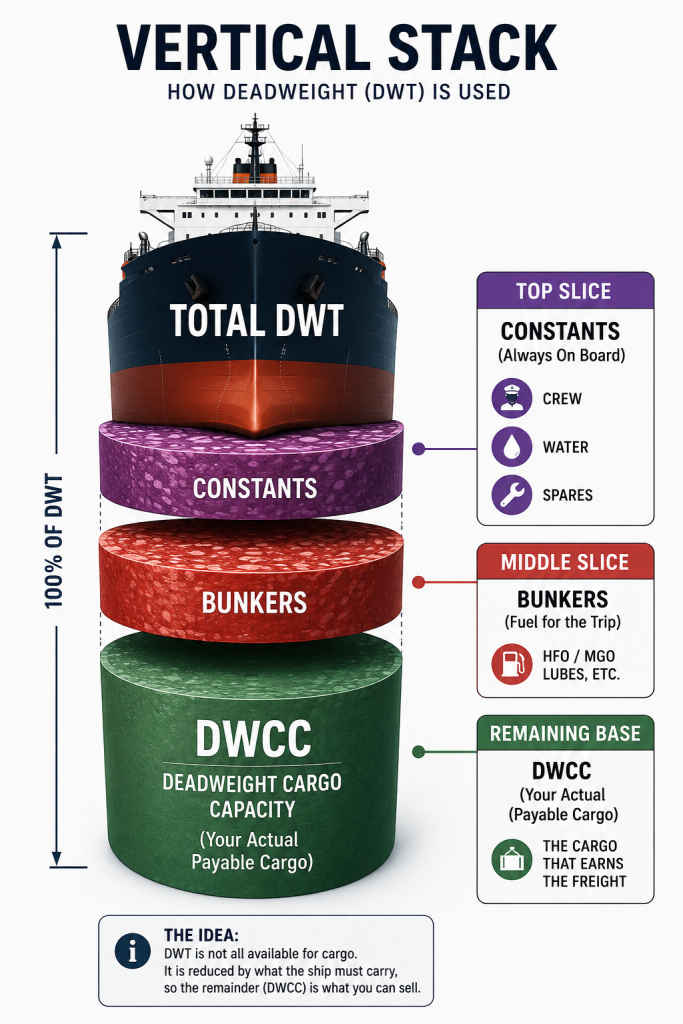
Infographic explaining Deadweight Cargo Capacity (DWCC) calculation: A vertical stack showing how Total DWT is reduced by Bunkers and Constants to reveal the actual payable cargo.
5. Leveraging “Eco-Speed” and Slow Steaming
A ship that arrives early may have to wait at the anchorage before its contents are offloaded. In the course of waiting, it may continue to use fuel despite standing still.
One saving strategy is to discover the sweet spot speed by intentionally reducing it from a typical 20–24 knots to 12–19 knots. This enables a vessel to consume less fuel while on the way, and thus lower its carbon emissions by 13–24%. Beyond that, slow steaming can translate into savings on bunkers if a port isn’t ready for the vessel.
Example:
A Panamax bulk carrier sailing from Santos to Rotterdam saved approximately $82,000 by slow steaming and avoiding congestion at a secondary discharge port.
6. Incorporating Carbon Costs (EU ETS & FuelEU)
As of 2024, shipping has been integrated into the EU Emissions Trading System (ETS). In 2026, companies are required to pay allowances for 70% of their reported emissions as part of the climate action plan.
This carbon risk must be factored into the voyage estimation calculations. Brokers can cut down their allowances by adopting fuel-efficient routes or travelling at Eco-speeds, hence saving thousands in regulatory costs per voyage.
Brokers aren’t just estimating costs; they are now advising owners on when to buy allowances to hedge against price spikes during the voyage.
The True Cost of a Voyage: Beyond the Surface
| Cost Factor | Why It Matters | Broker Action |
| Bunkers | Often, the largest voyage expense. Includes fuel price, quality, speed, and route that affect the total cost. | Compare bunker ports, optimize speed, and factor in fuel grade. |
| Port Disbursements | Docking, pilotage, towage, and cargo handling charges can vary widely by port. | Review all terminal and port charges before fixing the voyage. |
| Canal Dues | Routes through the Suez, Panama, or similar canals can add major cost and time. | Include transit fees and route alternatives in the estimate. |
| Laytime / Port Time | Delays, weekends, holidays, and notice periods can distort profitability. | Use realistic port time assumptions, not ideal loading rates. |
| Cargo Intake (DWCC) | Any unused cargo capacity can mean lost revenue. | Calculate DWCC carefully after deducting constants and bunkers. |
| Carbon Costs | Emissions pricing can materially affect net profit in regulated trades. | Factor in ETS/FuelEU costs and consider eco-speed routing. |
A voyage estimate is a pre-calculation of the potential profit of a trip, measured as the Time Charter Equivalent (TCE). Brokers analyze five main variables to find “hidden” savings:
Bunker Optimization
Bunkers typically represent the largest expense, often accounting for 50-70% of total voyage costs. This involves not just how much fuel is used, but also the location of the bunker.
Brokers seek out ports with lower refueling costs, or those with higher fuel quality, to minimize engine wear. A vessel’s fuel intake changes based on its speed, draft (laden vs. ballast), and weather conditions.
Fuel pricing also varies according to the grade of oil you are using. For instance, IMO sulfur regulations proposed a 0.50% sulphur limit for marine fuels, making it necessary to use low-sulfur fuels or alternatives like marine gas oil (MGO) or very low-sulfur fuel oil (VLSFO) to optimize engine operation and stay on top of emissions requirements.
Port Disbursements (D/A)
The ports at which your cargo will arrive have their own charges. These include the docking fees, pilotage, towage, and cargo handling fees. It’s crucial to factor in the port costs for all potential stops in the course of the voyage.
Canal Dues
If your vessel’s transit route goes through the Suez or the Panama Canal, you are likely to incur additional fuel costs as well as time to sail around. These will impact your overall profitability and must be included in your voyage estimation.
Voyage Time Calculation
In ship broking, the difference between a profitable voyage and a “paper loss” often comes down to how you estimate port time.
Most shippers go by the simple calculator, where they divide 49,000 tonnes by a 3,500-tonne loading rate to estimate the time spent in port. But this approach is flawed as it disregards the Standard SHEX (Sundays and Holidays Excepted) terms.
When you add weekends, notice time, and delays, the total port time can stretch to 20 days, 6 days ahead of your estimated 14-day period. These hidden days can lead to massive errors in calculating your daily costs.
Use the full realistic time allowance in your estimation, not just the demurrage costs, to buffer against unforeseen delays.
In fast-turnaround trades like sugar, ships often exceed their laytime. In these cases, account for dispatch money payments in your expenses to avoid unexpected financial surprises.
Precision in port time estimation isn’t simply a time-saving strategy but prevents thousands of dollars from being drained in unallocated voyage costs.
Example Voyage Estimate: Singapore to Rotterdam
Consider a Panamax bulk carrier transporting grain cargo from Singapore to Rotterdam under typical 2026 market conditions.
At first glance, the fixture may appear commercially attractive due to strong freight rates. However, once bunker consumption, Suez Canal dues, port disbursements, and EU ETS exposure are factored in, the margin can tighten quickly.
For this voyage, bunker expenses alone may exceed $500k, depending on:
- vessel speed,
- fuel grade,
- weather routing,
- and waiting time at the port.
Transiting through the Suez Canal could add another $200k+ in canal dues, while port costs at both ends of the voyage may approach $90k combined.
Laytime assumptions also play a major role. A seemingly minor delay of 3–4 days at discharge can materially reduce the voyage’s final Time Charter Equivalent (TCE), especially in congested European ports.
Carbon pricing now adds another operational layer. Under EU ETS requirements, emissions exposure on Rotterdam-bound voyages must be accounted for early in the estimation stage rather than treated as a post-voyage adjustment.
In this scenario, the broker’s advantage comes from identifying where operational efficiency can improve profitability:
- optimizing eco-speed,
- minimizing idle time,
- selecting competitive bunker ports,
- and building more realistic port-time assumptions into the estimate.
The result is a voyage plan based not on optimistic assumptions, but on commercially sustainable margins.
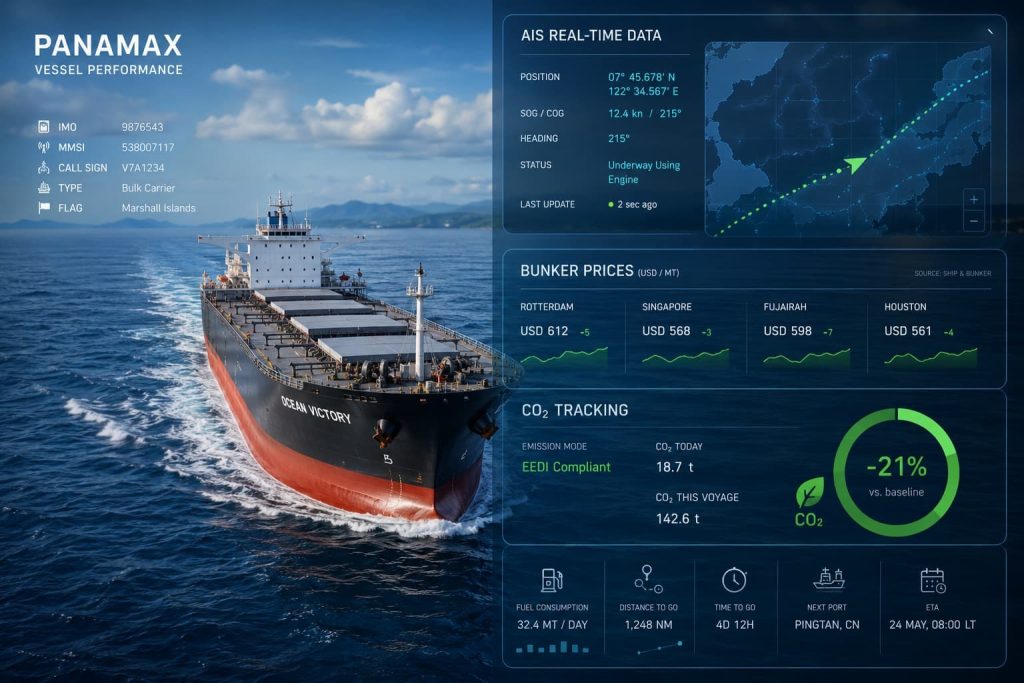
Digital voyage estimation dashboard overlaying a Panamax ship at sea, showing real-time AIS tracking, bunker fuel prices, and EU ETS carbon emission data for ship brokers.
Conclusion: The Data-Driven Broker Wins
Voyage cost estimation now stands as the key differentiator between the brokers who survive and those who thrive. But in 2026, the margin for error has narrowed further, with factors like EU ETS compliance, volatile bunker markets, and real-time port congestion making a vessel vulnerable to revenue leaks.
In short, a voyage estimated on gut feel or a basic spreadsheet is a costly one. The decisive advantage belongs to brokers who understand how external variables from laytime terms to eco-speed thresholds to carbon allowances act as a growth lever.
Voyage Management Systems and AI-powered estimation tools aren’t replacing broker judgment. They’re making it sharper, more precise, and accurate to turn ordinary fixtures into consistently profitable voyages — trip after trip.
FAQ
What is voyage cost estimation?
Voyage cost estimation is the process of forecasting the total cost and profit of a sea voyage before the charter is fixed. It accounts for variables like bunker prices, port disbursements, canal dues, laytime, and carbon costs that give brokers a realistic picture of whether a voyage is worth fixing and at what freight rate.
Why is laytime important in voyage estimation?
Laytime affects how long the vessel spends in port, which directly impacts fuel usage, daily costs, and final profitability. Poor laytime estimation is one of the most common sources of voyage cost overruns, with a 6-day miscalculation on a single port call losing thousands of dollars in projected profit. By integrating realistic port time assumptions into their estimates, including weekends, holidays, and notice periods, brokers can avoid the costly surprises that standard loading-rate calculations miss.
What does DWCC mean in shipping?
DWCC means Deadweight Cargo Capacity, or the amount of cargo a vessel can carry after deducting constants and bunkers such as crew provisions, fresh water, stores, and the bunkers required for the trip. It’s always lower than a vessel’s published DWT, and using DWT instead of DWCC in an estimate is a common mistake that leads to overstated revenue projections.
Why do brokers use digital tools for voyage estimation?
Digital voyage estimation tools give brokers access to real-time data across all these variables, reducing the risk of costly errors that static spreadsheets simply can’t catch. In competitive charter markets, that accuracy directly translates to better fixture decisions and protected margins.