
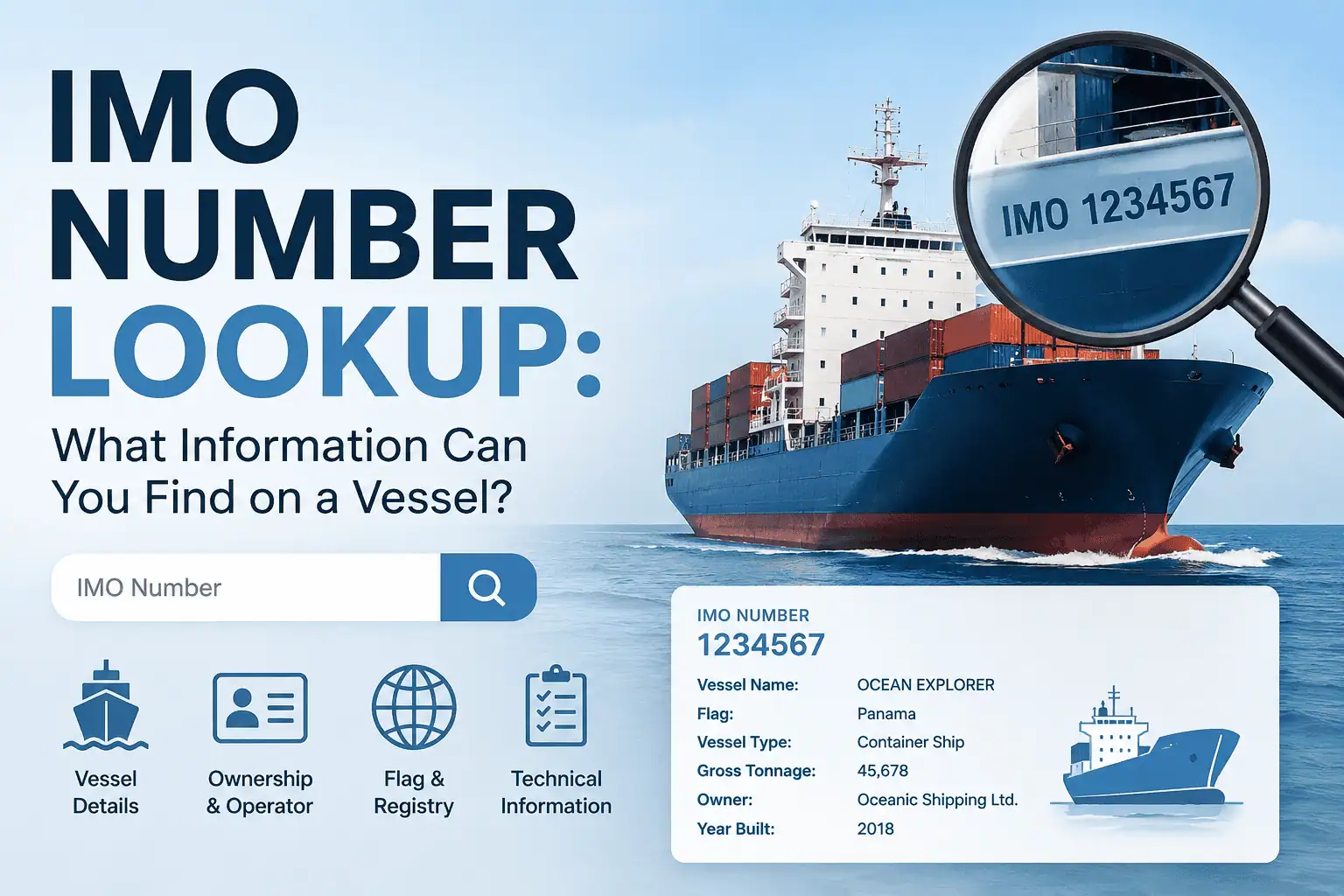
If you’ve ever needed to verify a ship’s identity — for a cargo shipment, a chartering deal, a marine insurance claim, or just curiosity after spotting a massive container vessel in port — you’ve probably run into the term “IMO number.” It looks like a random string of digits, but it’s actually one of the most useful tools in maritime research.
This guide breaks down exactly what an IMO number is, what data you can pull from one, and how to run a reliable lookup without getting lost in outdated or unofficial databases.
What Is an IMO Number?
An IMO number is a unique seven-digit identifier assigned to a ship by the International Maritime Organization. Unlike a vessel’s name, flag, or call sign — all of which can change over a ship’s lifetime — the IMO number stays with the vessel permanently, from the day it’s built until it’s scrapped.
Think of it like a VIN (vehicle identification number) for cars, but arguably more important, because ships routinely change owners, names, and even the country they’re registered in (their “flag state”). The IMO number is the one constant.
The format is always the same: the letters “IMO” followed by seven digits, such as IMO 9321483. That final digit is actually a checksum, calculated from the other six, which helps prevent typos and fraudulent entries.
Why the IMO Number System Exists
Before this numbering scheme became mandatory, tracking a vessel’s history was messy. A ship could be renamed, reflagged, or sold to a new operator, and its paper trail would effectively reset. This created real problems for safety regulators, insurers, and anyone trying to investigate a vessel involved in an incident.
The scheme was introduced in 1987 and became mandatory under SOLAS (the Safety of Life at Sea convention) for most cargo ships over 300 gross tonnage and passenger ships over 100 gross tonnage. Today it’s the backbone of global vessel identification.
Expert tip: Not every vessel has an IMO number. Small fishing boats, pleasure craft, and vessels under the tonnage threshold are typically exempt, so don’t be surprised if a lookup for a smaller or older vessel comes up empty.
What Information Can You Find Using an IMO Number Lookup?
This is the part most people actually care about. Once you plug an IMO number into a proper vessel database, here’s what typically surfaces:
1. Basic Vessel Identification
- Vessel name — including any previous names the ship has sailed under
- Call sign — the vessel’s radio identification code
- MMSI number — the Maritime Mobile Service Identity used for AIS tracking and radio communication
- Flag state — the country the vessel is registered under
- Vessel type — container ship, bulk carrier, tanker, cargo vessel, passenger ship, and so on
2. Technical Specifications
- Gross tonnage (GT) — a measure of the ship’s overall internal volume
- Deadweight tonnage (DWT) — how much weight (cargo, fuel, crew, provisions) the ship can safely carry
- Ship dimensions — length overall, beam (width), and draft
- Year built and shipyard of construction
- Engine and propulsion details on more detailed commercial databases
3. Ownership and Operations
- Registered owner and, where different, the beneficial owner
- Ship operator or manager, which is often a separate entity from the legal owner
- Classification society — the organization (like DNV, ABS, or Lloyd’s Register) responsible for certifying the vessel’s seaworthiness
4. Location and Movement History
- Current position, when cross-referenced with AIS tracking data
- Port calls — a log of ports the vessel has visited and when
- Voyage history, including estimated arrival times on active trackers
5. Historical and Safety Records
- Previous names and flag changes over the vessel’s lifetime
- Detention records from port state control inspections
- Incident or casualty history, where publicly reported
- Sanctions or watchlist flags, which matter enormously for compliance teams in shipping and trade finance
Here’s a quick reference table of what maps to what:
| Data Category | Examples of Information Revealed |
| Identity | Vessel name, previous names, call sign, MMSI |
| Registration | Flag state, IMO number, classification society |
| Specifications | Gross tonnage, deadweight tonnage, dimensions, year built |
| Ownership | Registered owner, operator, technical manager |
| Movement | Current position, port calls, voyage history |
| Compliance | Detentions, sanctions flags, incident history |
Case in point: During due diligence for a marine cargo insurance claim, an IMO lookup can reveal whether a vessel had a recent port state detention for safety deficiencies — information that can directly affect liability and claim outcomes. This is exactly the kind of record that wouldn’t surface from a vessel’s name alone, since names get reused or renamed after ownership changes.
How to Do a Vessel IMO Number Lookup (Step by Step)
- Locate the IMO number. It’s usually stamped on the ship’s hull, visible on shipping documents (bills of lading, charter parties), or listed in port authority records.
- Choose a reliable database. Options range from the official IMO GISIS platform to commercial vessel databases and AIS tracking sites (see the list below).
- Enter the number exactly as shown, including all seven digits. Dropping the leading zero (if there is one) is a common error.
- Cross-check the checksum if the tool doesn’t validate it automatically — this confirms you’re not looking at a mistyped number.
- Compare results across two sources if the data will inform a business or legal decision. Free public tools sometimes lag behind commercial databases in update frequency.
Where to Search
| Source Type | Best For | Access |
| IMO GISIS (official) | Verifying registration, certificates, audit status | Free, some sections require registration |
| Commercial vessel databases (e.g., Equasis, VesselFinder, MarineTraffic) | Specs, ownership, history, tracking | Free tier + paid detailed reports |
| Classification society registers | Class status, survey history | Often free to search |
| Port state control databases (e.g., Paris MOU, Tokyo MOU) | Detention and inspection history | Free |
Expert tip: Equasis, run with support from several maritime administrations, is one of the better free sources for ownership and inspection history because it aggregates data that would otherwise be scattered across multiple national registries.
Common Mistakes People Make During an IMO Lookup
- Confusing IMO number with MMSI number. The IMO number is permanent; the MMSI is tied to the vessel’s radio/AIS equipment and can change if that equipment or the flag registration changes.
- Relying on a single free database. Update frequency varies a lot between sources — a vessel sold last month might still show the old owner on a less-active site.
- Searching by vessel name instead of IMO number when accuracy matters. Names are reused constantly across the global fleet, which leads to mismatched records.
- Ignoring the checksum digit, which can catch data-entry errors before you waste time on a bad search.
- Assuming AIS position data is real-time and always accurate. Vessels can and do switch off or spoof AIS transponders, particularly in sanctioned trade routes — so treat live tracking as a strong indicator, not absolute proof of location.
Pros and Cons of IMO Number Lookups
Pros
- Universally standardized, so results are consistent across countries and registries
- Reveals a vessel’s full history, not just its current identity
- Useful for compliance, insurance, chartering, and safety verification
- Many core lookups are free through official or semi-official sources
Cons
- Some ownership data (especially beneficial ownership) can be layered through holding companies and harder to trace
- Free databases may not update in real time
- Smaller vessels below the tonnage threshold won’t have an IMO number at all
- Deep historical or technical reports often sit behind paid commercial platforms
Who Actually Uses IMO Number Lookups — and Why
- Freight forwarders and importers/exporters verifying the vessel carrying their cargo actually matches shipping documents
- Marine insurers and underwriters assessing risk based on a ship’s age, class status, and detention history
- Trade compliance and sanctions teams screening vessels against restricted lists before financing a shipment
- Ship brokers and charterers confirming specifications before negotiating a charter party
- Maritime researchers and journalists tracing a vessel’s ownership chain, especially in cases involving flag-of-convenience registrations
According to industry compliance reporting, sanctions evasion through vessel identity manipulation — such as AIS spoofing or flag-hopping — has become a growing focus area for maritime regulators in recent years. (For current statistics, source directly from OFAC, the UK’s OFSI, or maritime intelligence firms like Windward or Lloyd’s List Intelligence, as figures change frequently.)
Frequently Asked Questions
Is an IMO number the same as a vessel identification number?
Yes, “IMO number” and “vessel identification number” refer to the same thing in most contexts — the permanent seven-digit identifier assigned by the International Maritime Organization.
Can I look up a ship’s current location using its IMO number?
Indirectly, yes. The IMO number itself doesn’t broadcast location, but most vessel databases link it to the ship’s MMSI, which is used for AIS tracking, allowing you to see recent or live position data.
Is an IMO number lookup free?
Basic identification and registration details are usually free through sources like IMO GISIS or Equasis. Detailed ownership history, technical specs, or full inspection records sometimes require a paid subscription on commercial platforms.
Do all ships have an IMO number?
No. The requirement generally applies to self-propelled seagoing cargo ships of 300 gross tonnage and above, and passenger ships of 100 gross tonnage and above. Smaller vessels, fishing boats, and some government vessels are often exempt.
Why would a ship’s name not match its IMO number record?
Ships get renamed when they change owners, undergo rebranding, or are reflagged. The IMO number stays constant through all of this, which is exactly why it’s more reliable than searching by name.
What’s the difference between an IMO number and a call sign?
The IMO number is a permanent hull identifier. A call sign is a radio identifier tied to the vessel’s flag state registration, and it can change if the vessel reflags to a different country.
Conclusion: Key Takeaways
An IMO number is the single most reliable way to identify a vessel, verify its history, and confirm details that a name or call sign simply can’t guarantee. Whether you’re checking ownership before a charter deal, screening for sanctions risk, or just satisfying curiosity about a ship you saw in port, the process comes down to the same basics:
- Always search by IMO number, not vessel name, when accuracy matters
- Cross-check at least two databases for anything used in a business decision
- Remember that free tools are great for basics, but paid commercial platforms offer deeper ownership and history data
- Treat AIS-based location data as helpful, not infallible
Next time you need to verify a vessel, skip the guesswork — pull the IMO number and go straight to the source.