
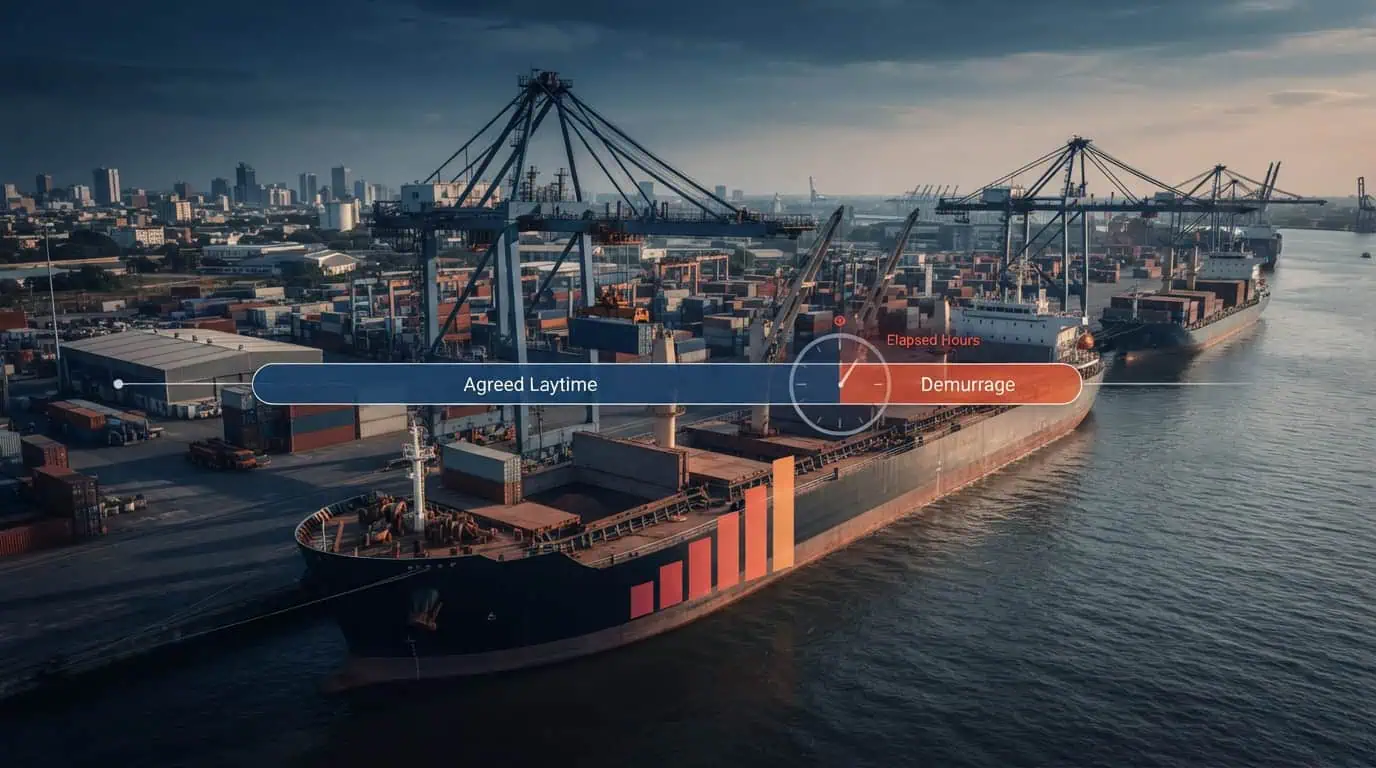
If you’ve ever stared at a charter party wondering why your vessel is racking up charges while it just sits at anchor, you’re not alone. Laytime and demurrage are two of the most misunderstood terms in maritime shipping and misunderstanding them is expensive.
Charterers, shipowners, brokers, and even cargo insurers deal with these terms constantly. Yet confusion between the two causes more contract disputes than almost any other clause in a charter party. This guide explains exactly what laytime and demurrage mean, how to calculate them, where people go wrong, and how to avoid unnecessary claims.
What Is Laytime in Shipping?
Laytime gives a charterer a set period under the charter party agreement to load or discharge cargo without incurring additional costs.
Think of it as a built-in grace period. The shipowner and charterer agree in advance on how many days (or hours) are “free” for loading and unloading. As long as the charterer finishes within that window, no additional charges apply.
Laytime is typically expressed in one of two ways:
- A fixed number of days or hours (e.g., “5 days laytime for loading”)
- A calculated rate based on cargo quantity and loading/discharge speed (e.g., “1,000 metric tons per weather working day”)
Why Laytime Exists
Laytime protects both parties. The shipowner gets a predictable timeline for vessel use, while the charterer gets a fair, agreed-upon window to handle cargo operations without rushing or facing penalties for reasonable delays.
Key Elements That Affect Laytime
- Notice of Readiness (NOR): Laytime usually doesn’t start until the vessel is “ready” in every respect and the master has formally notified the charterer or their agent.
- Weather working days: Many charter parties exclude days when weather prevents cargo operations from counting against laytime.
- Sundays and holidays (SHEX/SHINC): Whether these days count toward laytime depends on the specific charter party terms — SHEX means Sundays and holidays are excluded, SHINC means they’re included.
- Reversible vs. non-reversible laytime: Reversible laytime allows unused loading time to be added to discharge time (and vice versa); non-reversible laytime treats each separately.
What Is Demurrage in Shipping?
Demurrage is the penalty charge a charterer pays when cargo loading or discharging takes longer than the agreed laytime.
In plain terms: laytime is the free time, and demurrage is what you owe once that free time runs out.
Demurrage accrues at the daily (or pro-rata) rate specified in the charter party, starting when laytime expires and continuing until the vessel is released.
Why Demurrage Matters So Much
Demurrage isn’t a minor line item. For large dry bulk or tanker shipments, demurrage claims can run into hundreds of thousands of dollars for even a few days of delay. Port congestion, customs holdups, equipment breakdowns, or slow cargo handling are common triggers.
Because the financial stakes are high, parties frequently dispute demurrage clauses in maritime contracts, making them a common source of shipping arbitration.
Laytime vs Demurrage: Side-by-Side Comparison
| Feature | Laytime | Demurrage |
| Definition | Agreed free time for loading/unloading | Charge for exceeding laytime |
| When it applies | From NOR acceptance until laytime expires | After laytime expires |
| Cost to charterer | None (already priced into freight) | Daily rate specified in charter party |
| Purpose | Sets a fair working window | Compensates shipowner for vessel delay |
| Calculated by | Charter party terms + cargo quantity | Days/hours exceeding laytime × demurrage rate |
| Who benefits | Charterer (flexibility) | Shipowner (compensation for lost time) |
How Laytime Calculation Works
Laytime calculation sounds simple in theory but gets complicated fast once you factor in exclusions, interruptions, and port-specific customs.
Basic Laytime Formula
The most common formula is:
Laytime = Cargo Quantity ÷ Agreed Loading/Discharge Rate
For example, if a charter party specifies a loading rate of 2,000 metric tons per day, and the cargo is 10,000 metric tons, laytime allowed is 5 days.
Steps in a Laytime Calculation
- Confirm when the Notice of Readiness (NOR) was tendered and accepted.
- Determine the laytime commencement time (often after a fixed “turn time,” such as 6 or 12 hours after NOR).
- Track actual time used for loading/discharge operations.
- Subtract any excluded periods (weekends, holidays, bad weather, depending on SHEX/SHINC and weather clauses).
- Compare total time used against allowed laytime.
Expert Tip
Always keep a detailed Statement of Facts (SOF) signed by both the vessel’s agent and port authority. This document is the backbone of any laytime or demurrage calculation — and the first thing arbitrators ask for in a dispute.
How Demurrage Calculation Works
Once laytime expires, demurrage begins to accrue continuously, unless the charter party provides otherwise, until the vessel completes operations and the charterer releases it.
Basic Demurrage Formula
Demurrage = (Time Used − Allowed Laytime) × Demurrage Rate per Day
Example Demurrage Calculation
- Allowed laytime: 5 days
- Actual time used: 7.5 days
- Demurrage rate: $15,000/day
- Excess time: 2.5 days
- Demurrage owed: 2.5 × $15,000 = $37,500
Despatch: The Flip Side of Demurrage
Some charter parties include a despatch clause — a reward paid to the charterer if loading/discharge finishes faster than the allowed laytime. Despatch is usually calculated at half the demurrage rate, though this varies by contract.
Common Mistakes in Laytime and Demurrage Disputes
Even experienced charterers and operators run into the same recurring issues:
- Misreading SHEX/SHINC clauses — assuming weekends are excluded when the charter party says otherwise.
- Failing to tender NOR correctly — if NOR is rejected due to the vessel not being “ready,” laytime doesn’t start, even if the vessel is physically at berth.
- Not accounting for port congestion clauses — some charter parties have specific language for time lost due to congestion, which can shift financial responsibility.
- Poor documentation — missing or disputed timestamps in the Statement of Facts weaken a party’s position in arbitration.
- Ignoring exceptions clauses — force majeure, strikes, or equipment breakdowns may pause the laytime clock depending on contract wording.
- Assuming demurrage is capped — unless a “demurrage cap” or “once on demurrage, always on demurrage” clause exists, charges can accumulate indefinitely.
Pros and Cons of Standard Laytime/Demurrage Terms
Pros
- Creates predictability for both shipowners and charterers.
- Encourages efficient port operations since delays cost money.
- Provides a clear financial remedy for shipowners when delays occur.
- Well-established legal precedent (especially under English law, which governs most charter parties) makes disputes easier to resolve.
Cons
- Demurrage disputes can be costly and time-consuming to resolve, especially in arbitration.
- Port congestion outside anyone’s control can still trigger demurrage liability.
- Ambiguous charter party wording (especially around laytime exceptions) creates room for disagreement.
- Smaller charterers may face disproportionate financial risk from a single delayed shipment.
Real-World Example: Why the Difference Matters
Consider a dry bulk shipment of grain from a U.S. Gulf port to a buyer in Southeast Asia. The charter party allows 6 days laytime for loading, at a rate of $20,000/day demurrage.
Due to unexpected fog delaying berthing and a backlog at the terminal, loading takes 9 days instead of 6. That’s 3 days over laytime.
- Demurrage owed: 3 × $20,000 = $60,000
If the charter party had included a weather exception clause specifically covering fog, that clause might have excluded some or all of the delay from laytime, potentially saving the charterer tens of thousands of dollars. This shows why precise contract language matters so much in chartering.
(Note: For current average demurrage rates by vessel type and region, consult recent Baltic Exchange reports or a maritime P&I club’s annual claims summary, as rates fluctuate significantly with freight market conditions.)
Frequently Asked Questions
What is the main difference between laytime and demurrage?
Laytime is the free time allowed for loading or unloading cargo. Demurrage is the charge owed once that free time is used up.
Who pays demurrage — the shipowner or the charterer?
The charterer pays demurrage to the shipowner, since demurrage compensates the shipowner for the vessel being detained longer than agreed.
How is laytime calculated in a charter party?
The charter party typically determines laytime by dividing the cargo quantity by the agreed loading or discharge rate, then adjusting for exclusions such as weekends, holidays, or weather delays.
What happens when laytime expires?
Once laytime expires, the vessel is considered “on demurrage,” and the charterer begins owing demurrage charges for each additional day (or part of a day) until loading or discharge is complete.
Is there a limit to how much demurrage can accrue?
Generally, no — unless the charter party specifically includes a demurrage cap. Under the common law principle “once on demurrage, always on demurrage,” even normally excluded periods (like weekends) can count against the charterer once the vessel is on demurrage, unless the contract states otherwise.
What is despatch money?
Despatch is a payment the shipowner makes to the charterer when loading or discharge finishes before the allowed laytime, essentially the opposite of demurrage. It usually equals half the demurrage rate.
What is a Notice of Readiness (NOR) and why does it matter for laytime?
NOR is a formal notice from the vessel’s master stating the ship has arrived and is ready to load or discharge cargo. Laytime generally doesn’t begin until NOR is validly tendered and accepted, making it a critical trigger point in laytime calculation.
Can bad weather stop laytime from counting?
It depends on the charter party. If the contract specifies “weather working days,” time lost to bad weather that prevents cargo operations is typically excluded from laytime calculations.
Conclusion: Key Takeaways
Laytime and demurrage aren’t just shipping jargon — they’re financial mechanisms that directly affect the bottom line for charterers and shipowners alike.
Here’s what to remember:
- Laytime is the agreed free time for cargo operations; demurrage is the penalty once that time runs out.
- Precise charter party wording — especially around NOR, SHEX/SHINC, and weather exceptions — determines how laytime is calculated and whether demurrage applies.
- Keep detailed, jointly signed documentation (Statement of Facts) for every port call to support any future laytime or demurrage claim.
- Review demurrage rate clauses and caps before fixing a charter party, not after a dispute arises.
- When in doubt, involve a maritime lawyer or experienced chartering broker before signing — the cost of review is far lower than the cost of a demurrage dispute.
Understanding these terms isn’t just academic. It’s the difference between a smooth voyage and an expensive arbitration case.