What supply chain visibility means in 2026
Supply chain visibility in 2026 means knowing where your goods are, what condition they are in, and when they will really arrive, without calling anyone to ask. It also means knowing what will probably go wrong next, early enough to act.
That last part is the shift. A few years ago, visibility meant a dot on a map. Today it means a forecast, an alert, and a suggested fix.
Visibility, tracking and control are not the same thing
People use these terms as if they were interchangeable. They are not.
- Supply chain tracking answers: where is it right now?
- Supply chain visibility answers: where is it, what is around it, and what does that mean for my plan?
- Control and orchestration answers: given all that, what should we do, and can the system do it for us?
Most companies in 2026 sit somewhere between the first and second level. The winners are moving toward the third.
What end-to-end supply chain visibility covers
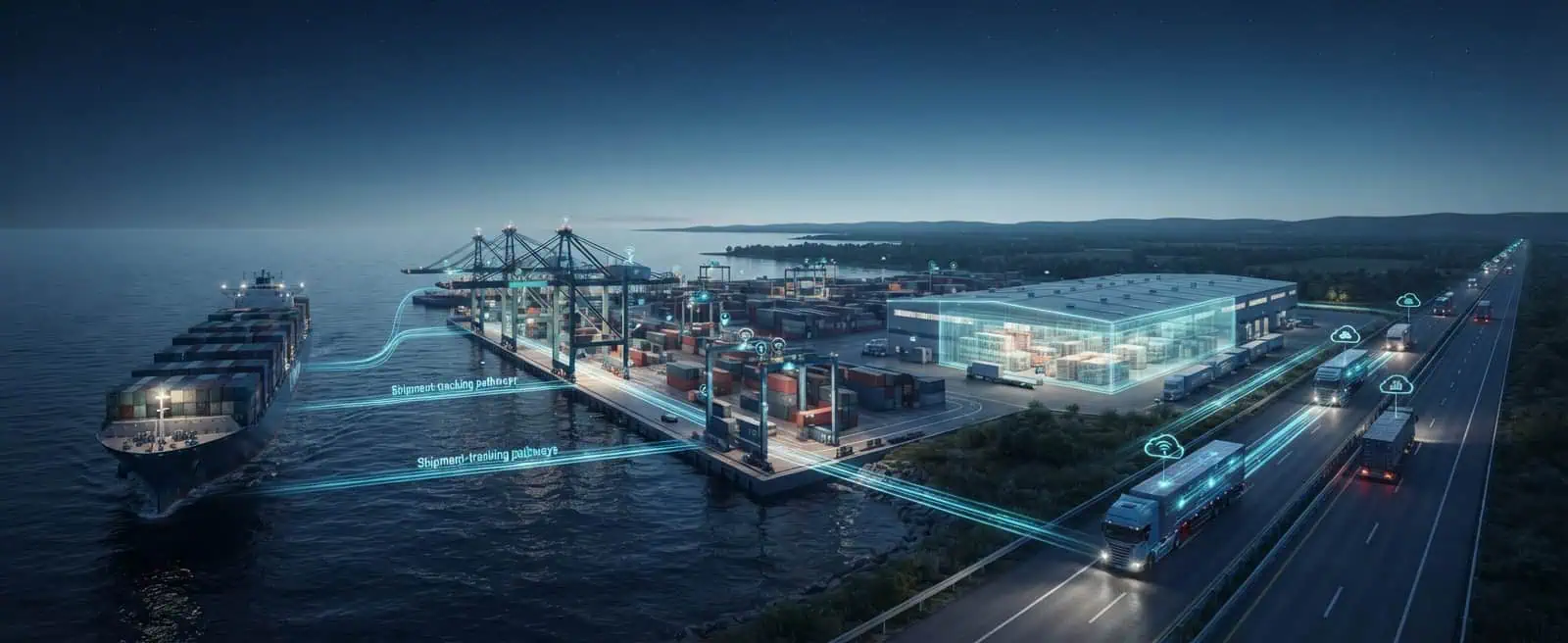
True end-to-end supply chain visibility follows a shipment from the supplier’s dock to the customer’s door. That includes:
- Supplier production status and purchase order milestones
- First-mile trucking and warehouse handoffs
- Ocean, air and rail legs, including transshipment ports
- Customs and border clearance
- Last-mile delivery and returns
A gap in any one leg breaks the chain. That is why integration matters as much as the sensors.
Why visibility has become a board-level issue
Visibility used to be an operations topic. Since the pandemic, the Suez Canal blockage and the Red Sea diversions, it has moved into the boardroom because delays now hit revenue, not just schedules.
Four pressures driving investment
- Disruption is the norm. Weather, port congestion, strikes, conflict and canal closures now arrive in clusters. Supply chain resilience depends on seeing them early.
- Customers expect Amazon-level answers. Buyers want an accurate delivery window, not a vague week.
- Working capital is expensive. When interest rates are high, safety stock costs more. Better visibility lets you hold less of it.
- Regulation and reporting are growing. Carbon reporting and supplier due-diligence rules need traceable, auditable data.
The numbers to cite (and where to find them)
We have not hard-coded figures here, because they change every year and you should link the original source. Add current data from:
- Gartner or McKinsey surveys on supply chain technology adoption and resilience spending
- Project44, FourKites or Descartes benchmark reports on ETA accuracy and dwell times
- UNCTAD Review of Maritime Transport for global shipping capacity and route disruption data
- World Bank Logistics Performance Index for country-level logistics performance
A useful stat to include is the share of shipments with a real-time ETA, and how much accuracy improves with predictive models versus carrier-declared ETAs.
The key technologies shaping global logistics in 2026
No single tool delivers visibility. The real value comes from how these layers connect.
1. IoT in logistics: sensors that report on their own
IoT supply chain tracking uses GPS trackers, RFID tags, temperature loggers, door sensors and shock monitors attached to pallets, containers and trailers.
What has changed is cost and battery life. Low-power devices can now report for months, which makes real-time cargo tracking realistic for mid-value goods, not just pharma and electronics.
Best for: cold chain, high-value cargo, theft-prone lanes, condition monitoring.
Watch out for: device cost per shipment, battery life, and data you collect but never use.
2. AIS data and live ship tracking
The Automatic Identification System (AIS) is the backbone of vessel tracking. Large ships on international voyages are required to carry AIS transponders, so position, speed and heading are broadcast continuously.
Providers combine terrestrial and satellite AIS to offer live ship tracking. Analysts then layer on port data, weather and historical routes.
AIS has real limits, and honest teams say so:
- Satellite coverage can leave short gaps in remote areas
- Signals can be switched off or spoofed
- Vessel position tells you about the ship, not about your box on it
That last point is why AIS alone is not container tracking.
3. Container tracking through APIs and standards
Container tracking links a container number to events: gate-in, loaded, discharged, gate-out. Data comes from carriers, terminals and sometimes the container’s own tracker.
The big 2026 trend is standardization. Industry bodies such as the Digital Container Shipping Association (DCSA) publish common data standards for track-and-trace events, so shippers no longer need a custom integration for every carrier.
4. AI and machine learning: predictive ETA and predictive logistics
This is where AI in logistics earns its keep. Predictive ETA models blend vessel position, port congestion, weather, berth schedules, historical delays and even customs patterns to estimate arrival more accurately than a carrier’s published schedule.
Predictive logistics goes a step further. It flags risk before it becomes a missed delivery, for example:
- A vessel slowing to save fuel, so the arrival slips by a day
- A terminal with rising dwell times
- A trucking lane with a pattern of late pickups
Artificial intelligence in supply chain work also helps with exception handling, matching invoices to shipments, and reading unstructured documents such as bills of lading.
Be careful: a model is only as good as its data. Ask any vendor how it measures ETA accuracy and how often it retrains.
5. Supply chain analytics and control towers
A control tower brings tracking feeds into one dashboard and layers rules and analytics on top. Good ones do three things:
- Show every shipment in one view across carriers and modes
- Rank exceptions by business impact, not by volume
- Trigger workflows, such as rebooking or notifying a customer
Supply chain analytics then turns the history into answers: which lanes are unreliable, which suppliers are late, and what buffer you really need.
6. Digital twins and scenario planning
A digital supply chain model mirrors your network in software. You can test what happens if a port closes or demand jumps 20 percent, before it happens.
Twins are powerful but data-hungry. Start with one critical flow, not the whole network.
7. Logistics automation
Visibility without action is just watching. Logistics automation closes the loop with tools such as:
- Automated appointment booking at warehouses
- Rule-based rerouting when a delay passes a threshold
- Auto-generated customer notifications
- Robotic process automation for document handling
Technology comparison at a glance
| Technology | What it tells you | Best use | Main limit |
| IoT sensors | Location and condition of cargo | Cold chain, high-value freight | Cost per device |
| AIS and vessel tracking | Where the ship is | Ocean ETA and port arrival risk | Does not show individual containers |
| Container tracking APIs | Milestone events per container | Ocean freight visibility | Event delays and carrier data quality |
| Predictive ETA (AI) | When it will really arrive | Planning and customer promises | Needs clean, broad data |
| Control tower and analytics | What matters most right now | Multi-carrier, multi-mode networks | Needs process change to pay off |
| Digital twin | What if scenarios | Network design and risk planning | Setup effort |
Maritime supply chain visibility in practice
About 80 percent of world goods trade by volume moves by sea, according to UNCTAD. That makes maritime supply chain visibility the hardest and most valuable part of the puzzle.
Case: the 2021 Suez Canal blockage
When the Ever Given ran aground in March 2021, the canal was blocked for about six days. Companies with live vessel tracking could see which of their ships were stuck, which had time to reroute, and which were days from the queue.
Those without it learned from news headlines and carrier emails. The lesson: visibility shortens the time between event and decision.
Case: Red Sea diversions
Since late 2023, many carriers have rerouted around the Cape of Good Hope, adding roughly one to two weeks on Asia to Europe trips. Predictive ETA models had to re-learn transit times fast, and shippers with automated rules could rebook and reset customer promises sooner.
Case: what TradeLens teaches about data sharing
TradeLens, a blockchain-based shipping platform launched by Maersk and IBM, was wound down around 2022 to 2023 after struggling to win broad industry participation. The technology worked. The challenge was neutrality and incentives.
The takeaway for 2026: open standards and APIs have beaten closed platforms. Pick tools that connect, not tools that lock in.
An illustrative example: connecting the dots
Imagine a retailer shipping apparel from Vietnam to Rotterdam, then by truck to Germany. In a mature setup:
- The purchase order milestone confirms cargo ready at the supplier.
- Container tracking shows gate-in and loading at the origin port.
- AIS data tracks the vessel, and a predictive ETA model flags a two-day slip due to port congestion.
- The control tower alerts planners and rebooks trucking automatically.
- The retailer updates the store replenishment date before shelves run empty.
No single step is magic. The value is in the chain reaction.
Pros and cons of real-time supply chain visibility
Visibility is worth it for most shippers, but it is not free and not automatic.
| Pros | Cons |
| Earlier warning of delays, so more time to act | Integration with carriers, ERPs and TMS takes real effort |
| More accurate ETAs and fewer customer surprises | Data quality varies by carrier, port and region |
| Lower safety stock and expedite costs | Subscription and device costs add up |
| Stronger evidence for carrier performance reviews | Alert overload if rules are not tuned |
| Better sustainability and compliance reporting | Data privacy and security need governance |
How to judge the return
Do not measure success by dashboards. Measure it by outcomes: fewer late deliveries, lower detention and demurrage fees, less premium freight, and fewer hours spent chasing updates by email.
How to build a visibility strategy: a practical roadmap
Start small, prove value, then expand. Big-bang rollouts tend to stall.
- Pick the pain. Choose one problem, such as late ocean arrivals on your top five lanes or cold chain excursions.
- Map your data. List where shipment data lives today: ERP, TMS, carrier portals, spreadsheets, emails.
- Set a baseline. Record current on-time rate, ETA error and hours spent on status checks.
- Choose connected tools. Prefer vendors that support standard APIs, EDI and DCSA-style event data.
- Pilot on one or two lanes. Run it for 8 to 12 weeks and compare to the baseline.
- Define the action rules. Decide who gets which alert, and what they should do.
- Scale and automate. Add modes, regions and automated responses once the pilot proves value.
Expert tips
- Start with exceptions, not the full map. Planners care about the 5 percent of shipments that are going wrong.
- Compare predicted ETA to carrier ETA. Track the gap for a month. It is the fastest way to prove value to finance.
- Share data with suppliers. Visibility that stops at your own dock leaves you blind upstream.
- Test vendors with your own data. Ask for a trial on your real lanes, not a demo on clean sample data.
- Assign a data owner. Someone must own quality, or the dashboard slowly stops being trusted.
Common mistakes to avoid
- Buying technology before defining the problem. A shiny control tower will not fix unclear ownership.
- Relying on AIS alone. Ship position does not equal container status. You need container-level events.
- Trusting carrier ETAs without checking them. Published schedules are often optimistic.
- Ignoring data quality. Messy master data, such as wrong container numbers or inconsistent location codes, breaks everything downstream.
- Creating alert fatigue. If every delay triggers an email, people stop reading them.
- Skipping change management. Teams must agree on what to do when an alert fires.
- Locking into a closed ecosystem. Choose open APIs so you can switch carriers and tools.
- Forgetting the upstream. Many delays start at the supplier, long before the cargo moves.
Frequently asked questions
What is supply chain visibility?
It is the ability to see where goods, orders and inventory are across your network, and increasingly to predict what will happen to them. It covers suppliers, carriers, ports, warehouses and customers.
What is the difference between real-time supply chain visibility and tracking?
Tracking shows location. Real-time supply chain visibility adds context, such as delays, risks and condition data, and often a forecast of the arrival time.
How accurate is predictive ETA?
It depends on data coverage and the model. Predictive ETAs generally beat static carrier schedules, especially on ocean lanes with congestion. Ask vendors for accuracy measured against actual arrivals on your lanes.
Can AIS data track my specific container?
No. AIS tracks the vessel. To follow a container you combine AIS with carrier or terminal events, or with an IoT device on the container.
Is live ship tracking free?
Some basic services offer free views, usually with delays or limited coverage. Professional-grade data with satellite AIS, history and APIs is typically paid.
How does AI help with supply chain resilience?
AI spots patterns humans miss: slowing vessels, rising port dwell times, supplier delays. It gives planners days of warning, not hours, and can suggest alternatives.
What is a good first step for a small or mid-size business?
Pick your highest-value or most delay-prone lane, use a container tracking tool with carrier integrations, and measure the change in late deliveries and time spent on status checks.
How long does implementation take?
A focused pilot can run in weeks. A full multi-modal, multi-region rollout usually takes several months, mostly due to integration and process work.
What are the biggest risks?
Poor data quality, low adoption by planners, and vendor lock-in. Cybersecurity and data sharing agreements also deserve attention.
Conclusion: where to start with supply chain visibility in 2026
Supply chain visibility in 2026 is no longer about seeing a dot move on a map. It is about turning IoT signals, AIS data, container events and AI forecasts into decisions that protect delivery promises and cash flow.
The technology is mature enough. What separates leaders is focus, data discipline and willingness to act on the alerts.
Actionable takeaways
- Choose one lane or product line where delays cost you the most
- Record your baseline on-time rate and ETA error this month
- Compare carrier ETAs with a predictive ETA for 30 days
- Require open APIs and standard event data from every vendor
- Write simple response rules for the top five alert types
- Extend visibility to your suppliers once the pilot works
- Review results quarterly and expand only what pays back