
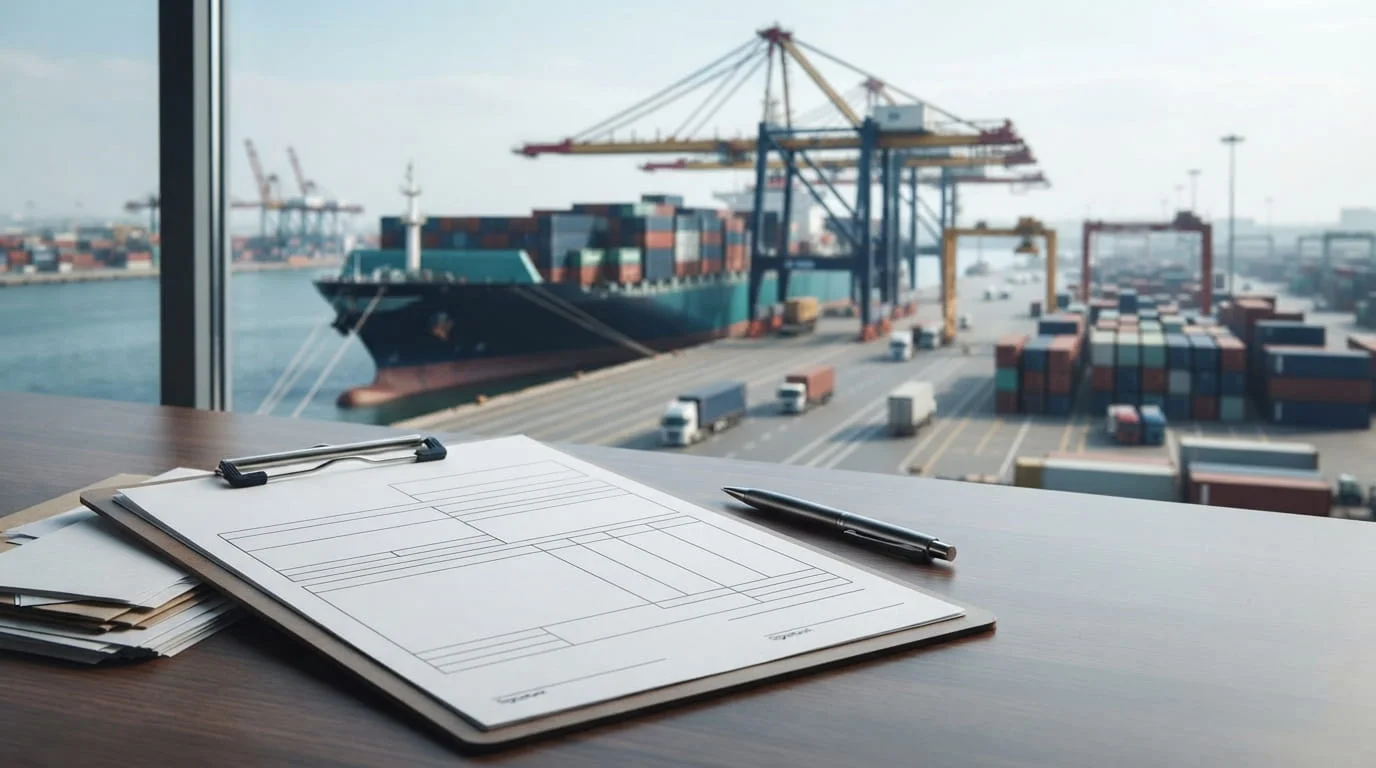
If you’ve ever shipped freight internationally or even received a pallet from a domestic trucking company you’ve dealt with a bill of lading, whether you realized it or not.
It’s one of those documents that sits quietly in the background of global trade, doing three jobs at once: proof of a contract, a receipt for goods, and (in some cases) the actual title to the cargo. Get it wrong, and a shipment can sit stuck at a port for weeks. Get it right, and it’s just paperwork you barely think about.
This guide breaks down what a bill of lading actually is, how it works, the different types you’ll run into, and the mistakes that trip up even experienced shippers.
What Is a Bill of Lading? (Bill of Lading Meaning)
A bill of lading (BOL) is a legal document issued by a carrier, a shipping line, trucking company, freight forwarder, or airline to a shipper. It confirms that the carrier has received a specific shipment of goods in good condition and agrees to transport them to a named destination for delivery to a specific party.
In plain terms: it’s the paper trail that says this cargo exists, this is what’s in it, this is where it’s going, and this is who’s responsible for it at every step.
The term “lading” comes from the old English word “lade,” meaning to load cargo onto a ship. Even though bills of lading now cover trucking, rail, and air freight too, the maritime origin is why the ocean version still carries the most legal weight.
The Three Legal Functions of a Bill of Lading
This is the part most guides skip, but it’s the actual foundation of why the document matters:
- Receipt of goods — Proof the carrier received the cargo as described (quantity, condition, packaging).
- Evidence of the contract of carriage — Confirms the terms agreed between shipper and carrier (though the full contract usually lives in the carrier’s separate terms and conditions).
- Document of title (for negotiable BOLs only) Whoever legally holds the original bill of lading has the right to claim the goods. This is the function that makes ocean BOLs so different from a simple delivery receipt.
That third function is what separates a bill of lading from every other shipping document. A packing list or commercial invoice can’t be traded, pledged as collateral, or used to transfer ownership of goods mid voyage. A negotiable bill of lading can.
Why the Bill of Lading Matters (Purpose and Importance)
The purpose of a bill of lading goes beyond “proof you shipped something.” Here’s what it actually protects:
- Legal protection — If cargo arrives damaged or short, the BOL is the reference point for claims and disputes.
- Payment and financing — Banks won’t release payment under a letter of credit without a compliant bill of lading. It’s central to trade finance.
- Chain of custody — Each party who touches the shipment (carrier, terminal, customs, consignee) references the BOL to confirm what they’re responsible for.
- Customs clearance — Customs authorities use BOL details to verify the shipment matches declared goods.
- Cargo release — At the destination port, the consignee typically can’t take possession of goods without presenting the original BOL (unless it’s a waybill more on that below).
Expert tip: Freight forwarders often say the BOL is the single most-checked document in a shipment’s lifecycle not because it’s complicated, but because a single typo (wrong container number, wrong consignee name, wrong Incoterm) can delay cargo at customs for days. Always cross-check the BOL against the commercial invoice and packing list before the vessel sails, not after.
How a Bill of Lading Works: Step by Step
- Booking — The shipper books cargo space with a carrier or forwarder.
- Cargo receipt — The carrier receives the goods and inspects the condition and quantity.
- BOL issuance — The carrier issues the bill of lading, naming the shipper, consignee, cargo description, and terms.
- Transit — The BOL travels alongside the shipment (physically or digitally) as proof of the contract.
- Presentation — At destination, the consignee (or a bank, in trade finance deals) presents the original BOL to claim the goods.
- Release — The carrier releases cargo once the correct, original BOL is surrendered.
That last step is where negotiable bills of lading create friction: if the original document hasn’t caught up with a fast ocean crossing (which happens more than people expect on short regional routes), cargo can sit at the port waiting for paperwork.
Types of Bill of Lading
This is where most confusion happens, because “types” of BOL actually describe several different classification systems layered on top of each other.
By Negotiability
| Type | Can Ownership Transfer? | Common Use Case |
| Negotiable Bill of Lading | Yes via endorsement | Open trade, letters of credit, when goods may be sold in transit |
| Non-Negotiable (Straight) Bill of Lading | No consigned to a named party only | Direct sales, intercompany shipments, no resale in transit |
Straight bill of lading: Goods are consigned to one specific party by name. That party and only that party can claim the cargo. It cannot be transferred or endorsed to someone else. It’s simple, but it removes flexibility if the buyer changes mid-shipment.
Negotiable bill of lading: Also called an “order” bill of lading. It can be endorsed and transferred to a new party, meaning ownership of the goods can change hands while the ship is still at sea. This is essential in commodity trading and letter-of-credit transactions, where banks hold the BOL as collateral until payment clears.
By Shipment Level
Master Bill of Lading (MBL)
Issued by the ocean carrier (the shipping line) to the freight forwarder or NVOCC (non-vessel operating common carrier). It covers the entire container or consolidated shipment load, from origin port to destination port.
House Bill of Lading (HBL)
Issued by the freight forwarder to the individual shipper. If your goods are one of several consolidated into a shared container, your HBL is your specific proof of shipment — even though the carrier’s MBL covers the whole container.
Expert tip: If you’re a smaller importer using a freight forwarder, the HBL is your document of record with the forwarder but the forwarder’s relationship with the ocean carrier runs on the MBL. If there’s a dispute, know which one actually governs your shipment. Read your forwarder’s terms carefully; HBL terms can differ meaningfully from MBL terms.
By Transport Mode / Format
- Ocean Bill of Lading — For sea freight; can be negotiable or non-negotiable.
- Inland Bill of Lading — For domestic trucking or rail.
- Through Bill of Lading — Covers multiple modes of transport (e.g., truck to port, then vessel) under a single document.
- Air Waybill (AWB) — The air freight equivalent, but notably never negotiable it’s always a receipt and contract, not a title document.
- Electronic Bill of Lading (eBOL) — A digital-native version gaining traction as carriers modernize; functionally equivalent to a paper BOL but transmitted and endorsed electronically.
Bill of Lading vs. Sea Waybill
This comparison confuses a lot of first-time importers, so it’s worth isolating.
| Feature | Bill of Lading | Sea Waybill |
| Document of title | Yes (if negotiable) | No |
| Original required for cargo release | Yes | No |
| Can be traded/endorsed | Yes (negotiable version) | No |
| Speed of cargo release | Slower must wait for original | Faster consignee ID is enough |
| Best for | Trade finance, resale in transit | Trusted trade partners, intercompany shipments |
A sea waybill works like a receipt and contract of carriage but is not a title document. The named consignee just has to prove their identity to collect the goods no original paper needed. It’s faster and simpler, but it only works when there’s no need to transfer ownership mid-voyage and both parties trust each other (common between related companies or long-term partners).
Key Information on a Bill of Lading
A standard bill of lading document includes:
- Bill of lading number — Unique reference used to track the shipment across every system it touches (carrier, customs, port terminal)
- Shipper name and address
- Consignee name and address
- Notify party (often the importer’s customs broker)
- Vessel/voyage number or flight/truck details
- Port of loading and port of discharge
- Cargo description, weight, and package count
- Container number(s) and seal number(s)
- Freight terms (prepaid or collect)
- Date of issue and carrier signature
Expert tip: The bill of lading number is the fastest way to track a shipment across carrier portals, customs systems, and port authority databases. Save it the moment it’s issued — it’s referenced in nearly every follow-up communication about that shipment.
Bill of Lading Requirements
To be legally valid and functional, a bill of lading generally needs:
- Accurate, complete cargo description matching the commercial invoice
- Correct named parties (shipper, consignee, notify party)
- Carrier’s signature or authorized agent stamp
- A clean designation — “clean” means no noted damage or discrepancy at loading; a “claused” or “dirty” BOL notes visible damage or shortages, which can affect insurance claims and buyer acceptance
- Consistency with the letter of credit terms, if trade finance is involved (banks reject BOLs with even minor mismatches)
Common Mistakes With Bills of Lading
- Mismatched details — Cargo description or weight on the BOL doesn’t match the commercial invoice or packing list, triggering customs delays.
- Wrong consignee name — Even small spelling differences can prevent cargo release or letter-of-credit acceptance.
- Using a straight BOL when negotiability is needed — Locks the shipment to one buyer, which is a problem if a resale happens in transit.
- Losing the original negotiable BOL — Without it, claiming cargo becomes a slow legal process involving indemnity bonds.
- Ignoring “claused” status — Accepting a claused (dirty) BOL without adjusting insurance or payment terms accordingly.
- Assuming a sea waybill works for a letter-of-credit deal — It typically doesn’t, since banks want title-document control.
Pros and Cons of Negotiable Bills of Lading
Pros:
- Enables resale of goods while in transit
- Required and trusted for letter-of-credit trade finance
- Provides strong legal protection as a title document
Cons:
- Slower cargo release original document must physically or electronically reach the destination
- Risk of delay or loss of the physical original
- More administrative overhead than a waybill
Cargo Shipping Documents: Where the BOL Fits
The bill of lading is the centerpiece, but it works alongside other freight shipping documents:
- Commercial invoice — States the transaction value for customs and payment
- Packing list — Details exact contents, weights, and dimensions per package
- Certificate of origin — Confirms where goods were manufactured, relevant for tariffs
- Letter of credit — Bank-issued payment guarantee, often tied directly to BOL presentation
- Customs declaration — Formal filing for import/export clearance
- Insurance certificate — Proof of cargo insurance coverage
Together, these form the documentary backbone of ocean freight and cargo shipping — but the BOL is the only one that can also function as a title to the goods.
A Simple Bill of Lading Example
Picture a US furniture importer buying a container of goods from a manufacturer in Vietnam:
- The manufacturer books space with an ocean carrier and hands over the cargo.
- The carrier issues a master bill of lading to the freight forwarder handling the shipment.
- The forwarder issues a house bill of lading to the importer, naming them as consignee.
- Because payment is via letter of credit, the BOL is negotiable the bank holds it until the importer pays.
- Once payment clears, the bank endorses the BOL over to the importer.
- The importer presents the original BOL at the US port to release the container.
This is a textbook example of how the three legal functions of a BOL receipt, contract evidence, and title work together in a real transaction.
Frequently Asked Questions
What does BOL mean in shipping?
BOL stands for bill of lading the document a carrier issues confirming receipt of cargo and the terms under which it will be delivered.
Is a bill of lading the same as an invoice?
No. A commercial invoice states the value of goods for payment and customs purposes. A bill of lading is a shipping and legal document proving receipt, contract terms, and (if negotiable) title to the goods.
Who issues the bill of lading?
The carrier an ocean line, airline, or trucking company or their authorized agent, such as a freight forwarder issuing a house bill of lading.
Can a bill of lading be transferred to someone else?
Only if it’s a negotiable (order) bill of lading. A straight bill of lading is locked to the named consignee and cannot be transferred.
What happens if the original bill of lading is lost?
The consignee typically needs to provide an indemnity bond to the carrier before cargo will be released without the original, a slower and more costly process.
Do domestic truck shipments need a bill of lading?
Yes. Inland/domestic BOLs are standard in trucking and function as the receipt and contract of carriage, though they’re almost always non-negotiable.
Is an electronic bill of lading legally valid?
Increasingly, yes. Electronic bills of lading are gaining legal recognition under frameworks like the UK’s Electronic Trade Documents Act and are supported by major carriers, though acceptance still varies by country and banks always confirm with your trade finance partner first.
Conclusion: Key Takeaways
A bill of lading isn’t just paperwork it’s the legal backbone of a shipment. It proves what was shipped, sets the terms of carriage, and in its negotiable form, controls who actually owns the cargo.
Before your next shipment, make sure you:
- Confirm whether you need a negotiable or straight bill of lading based on your payment terms
- Double-check every detail against your commercial invoice and packing list before the BOL is finalized
- Know whether your forwarder relationship runs on a house BOL or the carrier’s master BOL
- Save your BOL number immediately you’ll need it for tracking and customs
- Ask your bank early if a letter of credit is involved, since BOL requirements are strict and unforgiving of errors
Get the bill of lading right, and everything downstream customs, payment, delivery moves faster.