
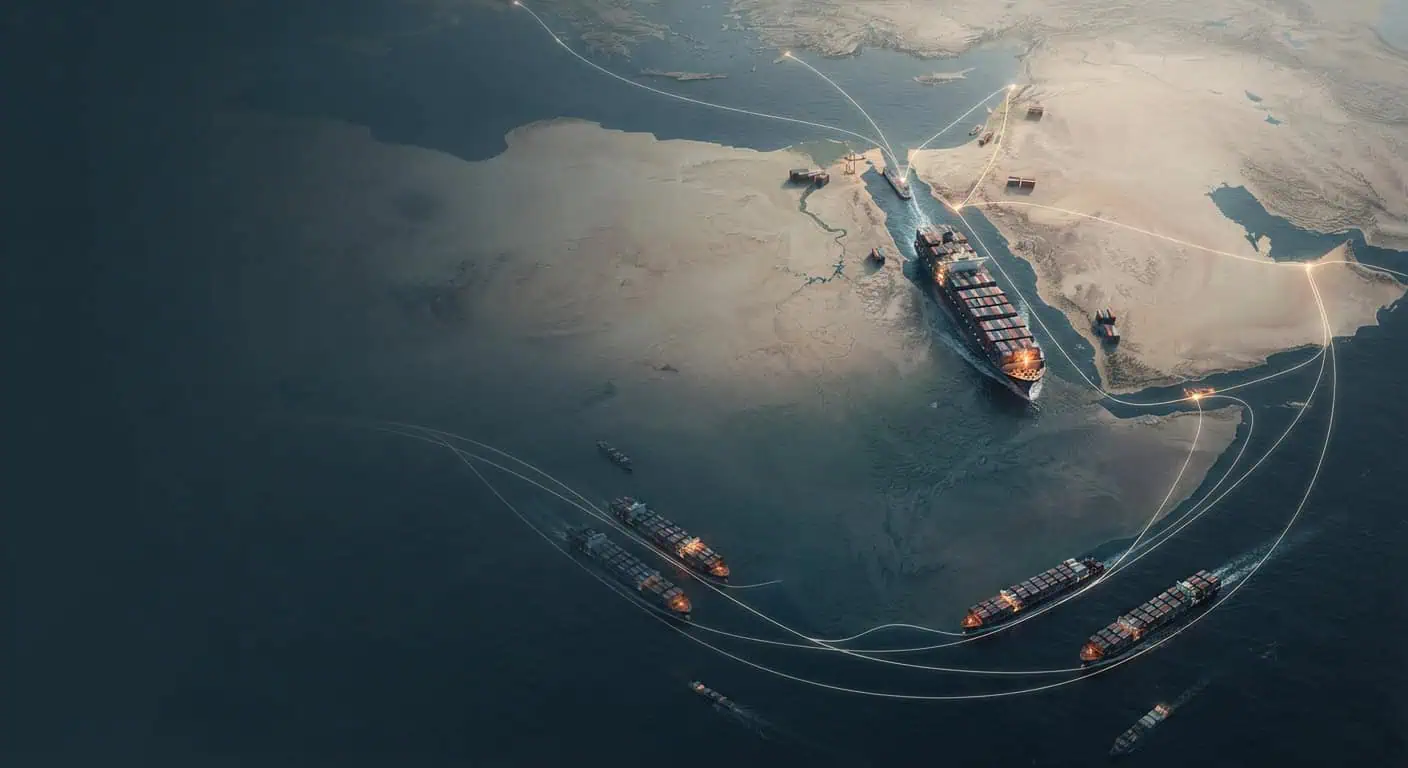
The Suez Canal crisis is the long disruption to Red Sea and Suez Canal shipping that began in late 2023. Attacks on merchant ships pushed most big container lines to sail around Africa instead.
That one decision rippled through every part of the maritime supply chain: transit times, freight rates, port schedules, inventory plans, and prices on store shelves.
Why the canal matters
The Suez Canal is the shortest sea link between Asia and Europe. Before the crisis, it carried roughly 12% of global trade and about 30% of container traffic (approximate figures commonly cited; confirm against the latest UNCTAD or Suez Canal Authority data before publishing).
Before the attacks, the canal handled about 70 to 80 vessels a day. During the worst stretch in 2024 and 2025, that fell to as low as 30 to 35, according to Suez Canal Authority figures reported by Daily Beirut.
What triggered the Red Sea shipping crisis
Houthi attacks on commercial vessels near the Bab el-Mandeb Strait, the southern gate of the Red Sea, made the route too risky for many carriers. Crew safety, cargo safety, and insurance all became problems at once.
Container lines shifted fast. According to Xeneta, container ship transits fell from 583 in October 2023 to just 120 in November 2025. The ships that kept going were mostly smaller carriers on regional trades with lower risk.
Where the Suez Canal shipping crisis stands now (October 2026)
The short answer: partial recovery, not normal. Traffic is climbing, but every carrier’s decision still depends on security.
The recovery in numbers
- August 2026: 1,358 vessels used the canal, up 27% from a year earlier, with $567.1 million in revenue (Daily Beirut, citing the Suez Canal Authority).
- First eight months of 2026: 9,602 vessels, up 17.3% year on year (same source).
- Week 39 of 2026: Suez transits ran 68% higher than the same week last year, per Drewry’s World Container Index commentary.
Even with that rebound, traffic is far below the pre-crisis level of 70 to 80 ships a day.
Carriers are returning service by service
Big lines are not flipping a switch. They are moving one loop at a time, often starting with the backhaul leg, which carries less cargo.
As of late September 2026, one industry tracker reports that selected services from CMA CGM, Maersk, MSC, Hapag-Lloyd, and COSCO were back in the canal, while Evergreen, ONE, HMM, and Yang Ming had not returned (Carra Globe; verify against carrier advisories before you publish).
Why the return keeps stalling
The route has reversed before. In early 2026, Maersk announced a structural return on its MECL service. Then US-Israel strikes on Iran in March led Maersk to move its ME11 and MECL services back to the Cape, as Air Cargo News reported.
One industry tracker also reports that war risk claims have topped $2 billion (Mighty Shipping). Treat that as a sign of how costly the risk remains, and check the figure against insurers’ own reports.
Expert tip: Carriers hate “double disruption,” meaning a switch to Suez and then back to the Cape. That is why they test slowly and why announced plans can change with one news event.
How the Suez Canal disruption hits global supply chains
The Suez Canal impact on supply chains shows up in five places. Some are obvious. Some only appear weeks later.
Longer routes through the Cape of Good Hope
Sailing the Cape of Good Hope shipping route adds roughly 3,500 nautical miles and about 10 to 14 days to a typical Asia–North Europe voyage (approximate; cite a carrier or Drewry source). For Asia to the US East Coast, one source puts the delay at 8 to 12 days (Suaid Global).
Longer trips mean slower inventory turns and more cargo sitting on the water instead of in your warehouse.
Container shipping delays and unreliable schedules
The delay itself is manageable if it is predictable. The bigger problem is variability. A late vessel can miss its berth window and trigger a chain of cargo delays at the port, at the rail yard, and at the distribution center.
Vessel bunching and port congestion
When ships sail longer routes, fewer arrive each week, and then several arrive together. Ports see surges that their crews and yards cannot absorb.
A return to Suez creates the same problem in reverse. As Xeneta notes, ships and containers can arrive a week earlier than planned when carriers test the route without warning.
Tight equipment and capacity
A longer loop ties up more ships and containers per service. Shorter loops free capacity. When CMA CGM moved its INDAMEX service back through Suez, it was able to drop two vessels from the rotation, according to CXTMS, which shows how much capacity the Cape route absorbs.
Planning risk
Planners cannot set safety stock if they do not know whether a ship will sail via Suez or the Cape. This uncertainty is often more expensive than the extra days.
Ocean freight rates and the cost of rerouting
Ocean freight disruption hits budgets through freight rates first, then through surcharges, fuel, and insurance.
Where rates are today
On 1 October 2026, Drewry’s World Container Index fell 1% to $4,434 per 40ft container. Drewry points to growing Suez transits adding effective capacity on Asia–Europe, which puts downward pressure on rates.
On 3 September, Shanghai–Genoa fell 10% to $4,368 per 40ft container and Shanghai–Rotterdam fell 5% to $4,092, per Mighty Shipping’s summary of Drewry data.
For context, Xeneta estimates that Asia–Europe services made up about 64% of the 6.4 million TEU passing through Suez each month in 2023.
What drives the extra cost
| Cost driver | Why it rises with rerouting | Who feels it |
| Fuel and bunkers | More miles per trip | Carriers, then shippers via surcharges |
| Extra ships per loop | Longer loops need more vessels | Carriers, via spot and contract rates |
| War risk insurance | Premiums spike for Red Sea transits | Carriers and cargo owners |
| Emergency surcharges | Added to offset diversion costs | Shippers |
| Port congestion | Bunched arrivals, storage and detention fees | Importers and exporters |
| Inventory carrying cost | More days of cargo in transit | Retailers and manufacturers |
Why a return to Suez can also hurt
More capacity should lower rates over time. But analysts, including ING, warned that a big return would first trigger congestion in European ports, then price pressure on carriers.
In plain terms: good news for shippers eventually, messy in the middle.
Expert tip: Avoid locking your whole annual volume at a single rate. Split between contract and spot, and add a review clause tied to a public index such as Drewry’s WCI or the Freightos Baltic Index.
Impact of the Suez Canal crisis on global trade: industries and regions
The impact of the Suez Canal crisis on global trade is uneven. Some sectors can wait a few extra weeks. Others cannot.
Who is hit hardest
- Retail and fast fashion: Seasonal goods that arrive late lose sales. Late Christmas stock is nearly worthless in January.
- Automotive and electronics: Just-in-time factories run on tight parts schedules. A missing component can stop a whole line.
- Energy: Tankers adjust routes and insurance costs, which feed into delivered fuel prices.
- Mediterranean and Northern Europe ports: They absorb the swings in arrival timing.
- Egypt: Lower transits cut canal revenue sharply. Official data show revenue fell 61% in 2024, to about $3.99 billion (Daily Beirut).
Case study: Ever Given, 2021 vs. today
In March 2021, the container ship Ever Given blocked the canal for about six days. That was a sudden, one-time blockage, and the backlog cleared in weeks.
The current crisis is a different animal. It is slow, security-driven, and uncertain. A blockage is a traffic jam. A security crisis is a decision every carrier makes again every month.
Case study: factories that felt it first
In early 2024, several European manufacturers, including Tesla’s Berlin plant and Volvo’s Ghent plant, reported production pauses linked to Red Sea disruption (widely reported at the time; add a primary source link when you publish).
The lesson: for just-in-time manufacturers, an extra 10 days is not a rounding error. It is a missing part on a Tuesday.
Global maritime trade is adjusting, not stopping
Global maritime trade has kept moving. Cargo reaches ports. But the shape of the network has changed: longer loops, more transshipment, and more careful use of alternate routes. The Strait of Hormuz closure reported in May 2026 (Maritime News) shows how one chokepoint problem can stack on top of another.
How to build supply chain resilience
Supply chain resilience is not about guessing the right route. It is about staying profitable whichever route carriers choose.
Practical steps
- Map your exposure. List which lanes, suppliers, and SKUs depend on Suez or Cape routings.
- Add buffer by SKU. Raise safety stock for high-margin or hard-to-replace items, not everything.
- Diversify carriers and ports. Don’t rely on one line or one gateway.
- Use container tracking and vessel tracking. Track both bookings and ships so you see route changes early. Ask your forwarder for AIS-based alerts.
- Negotiate flexible contracts. Index-linked rates and reroute clauses reduce surprises.
- Talk to your carrier about routing. Ask which services are planned via Suez, and what triggers a switch back to the Cape.
- Run scenarios. Plan for three cases: Cape routing continues, partial Suez return, full return with congestion.
Pros and cons of shipping via Suez vs. the Cape
| Route | Pros | Cons |
| Suez Canal / Red Sea | Shorter transit, lower fuel use, fewer ships needed, can lower rates | Security risk, higher war risk insurance, sudden route reversals |
| Cape of Good Hope | More predictable and safer, proven for two years | Longer transit, higher fuel use and emissions, ties up more capacity |
Common mistakes
- Assuming the crisis is over because transit numbers are up. Traffic is rising, but carriers say routing depends on security.
- Planning on a single route. Carriers can switch with little notice.
- Watching only the freight rate. Surcharges, detention, and storage can add as much as the base rate.
- Ignoring arrival bunching. Early or late clusters of ships can swamp ports.
- Using old lead times. A transit time from 2022 is no longer a safe planning number.
- Skipping tracking. Without visibility, you hear about delays from customers, not from your system.
Expert tip: Ask your forwarder one question every month: “Which of my services changed route in the last 30 days, and which are at risk of changing in the next 30?” The answer is worth more than a rate quote.
Suez Canal crisis FAQs
Is the Suez Canal open right now?
Yes. The canal itself is open and traffic is rising. Whether your cargo goes through it depends on your carrier’s service and its risk call.
Why are ships still going around the Cape of Good Hope?
Because security risks remain, insurance is costly, and carriers want to avoid switching back and forth. Many services still use the Cape as the default.
How long do Suez Canal shipping delays last?
Rerouting typically adds about 10 to 14 days on Asia–Europe trips, plus schedule variability. The delay depends on the trade lane and the service.
Will freight rates fall if carriers return to Suez?
Probably, over time, because shorter loops free capacity. Analysts also expect short-term port congestion first. Rates are already easing on Asia–Europe, according to Drewry.
Which carriers use the Red Sea again?
It changes often. As of late September 2026, several of the largest lines had selected services back in the canal and others had not. Check each carrier’s live advisories.
How does the Suez Canal crisis affect consumers?
Mostly through delayed products, higher shipping costs passed on in prices, and occasional stock shortages. The effect is usually modest per item but adds up across a supply chain.
How can I track a container or vessel affected by rerouting?
Use your carrier’s tracking page, a freight visibility platform, or AIS-based vessel tracking. Check the routing field, not just the ETA.
Is this the same as the 2021 Ever Given blockage?
No. Ever Given was a six-day physical blockage. This crisis is a security-driven change in route choice that has lasted years.
Conclusion: what to do next
The Suez Canal crisis has moved from shock to a long, uneven transition. The canal is busier, rates are easing on Asia–Europe, and carriers are testing a return. But the risk is still priced in, and routes can reverse.
For shippers, the winning move is flexibility, not prediction.
Actionable takeaways
- Map which of your lanes and SKUs depend on Suez or Cape routing this quarter.
- Ask your forwarder for monthly routing updates and early-warning alerts.
- Use index-linked or split contracts so rate swings do not catch you out.
- Raise safety stock only where a delay would cost real revenue.
- Plan for early arrivals as well as late ones when carriers switch routes.
- Review lead times against current data every quarter.