If you work in freight, logistics, or supply chain planning, you’ve probably felt the ripple effects of Panama Canal challenges even if you’ve never seen the canal in person. A backed-up queue of container vessels in Gatun Lake can push up freight rates in Rotterdam, delay a furniture shipment in Ohio, or force a carrier in Singapore to reroute around Africa.
This isn’t a hypothetical. It already happened. During the 2023–2024 drought, the Panama Canal Authority (ACP) cut daily transits from a normal range of 36–38 vessels down to just 18 by February 2024 — a record low for the modern canal. That single decision rippled through container shipping, dry bulk, and LNG markets for more than a year.
This guide breaks down what’s actually driving Panama Canal problems today, how vessel restrictions and traffic congestion affect cargo ships, what it means for shipping costs and delivery timelines, and what shippers can realistically do about it.
Why the Panama Canal Matters to Global Trade
The Panama Canal isn’t just a shortcut — it’s core shipping infrastructure. The 50-mile waterway lets vessels cross between the Atlantic and Pacific without sailing around South America, cutting weeks off many voyages.
Key facts that explain why disruptions here matter so much:
- The canal handles roughly 6% of global maritime trade by volume.
- It’s a critical link for U.S. East Coast and Gulf Coast ports receiving goods from Asia.
- It moves everything from containerized consumer goods to LNG, grain, and vehicles.
- Panama Canal Authority (ACP) reported record revenue of $5.7 billion in fiscal year 2025, on roughly 13,404 transits, showing just how much trade flows through this single chokepoint.
Expert tip: When you’re modeling supply chain risk, treat the Panama Canal the way you’d treat any single point of failure in a network — not just a route, but a dependency. If it slows down, your alternatives (Suez Canal, Cape of Good Hope, West Coast rail) all get more expensive at the same time, because everyone is trying to use them at once.
The Core Panama Canal Challenges Facing Cargo Ships
1. Drought and Water Shortage
The single biggest Panama Canal challenge is water — specifically, freshwater.
Unlike the Suez Canal, which is a sea-level waterway, the Panama Canal is a freshwater lock system. Every transit uses millions of gallons of water from Gatun Lake and Alhajuela Lake to raise and lower ships through the locks. That water isn’t recycled back into the ocean — it eventually flows out to sea, and it also supplies drinking water to about 2 million Panamanians.
When rainfall drops, so does lake capacity, and so does the canal’s ability to run at full speed.
During the 2023–2024 El Niño drought, Gatun Lake fell to about 79.6 feet in August 2023 — well below its normal operating range. The result:
- Daily transits were slashed from the normal 36–38 down to as low as 18 per day by February 2024.
- Maximum draft for Neopanamax vessels was cut to as low as 44 feet, well under the design maximum of 50 feet.
- Wait times to enter the canal stretched from a typical 3–5 days up to 11 days on average.
The canal has since recovered. By mid-2025, ACP administrator Ricaurte Vasquez confirmed the canal was “operating at full water capacity” with draft restored to 50 feet. But the recovery came with a catch — and a new warning.
As of mid-2026, forecasters were watching a new El Niño pattern, with NOAA estimating a very high probability of El Niño conditions forming by late 2026. In response, the ACP had already announced its fourth and fifth draft reductions of the year by August 2026, tightening the maximum authorized draft at the Neopanamax locks to around 49.5 feet. Officials described this as proactive water management rather than a full repeat of 2023–2024 — but it’s a clear signal that drought risk at the canal is now a recurring, not a one-time, problem.
Expert tip: Don’t treat “the canal is back to normal” as a permanent status. Water levels at the Panama Canal now behave more like a seasonal risk factor — similar to hurricane season for Gulf ports — that should be built into annual planning, not just crisis response.
2. Vessel Draft Restrictions
Draft restrictions are the canal’s main lever for managing low water. Draft is how deep a ship sits in the water — and the deeper it sits, the more water the locks need to lift it safely.
When water levels fall, the ACP reduces the maximum permitted draft. That forces ships to carry less cargo, because a lighter ship rides higher in the water.
| Condition | Typical Max Draft (Neopanamax) | Typical Daily Transits |
| Normal operations | ~50 ft (15.24 m) | 36–38 |
| 2026 tightened restrictions | ~49.5 ft (15.09 m) | Reduced, case-by-case |
| Peak 2023–2024 drought | As low as 44 ft | As low as 18 |
Note: Figures reflect publicly reported ACP announcements through mid-2026; exact daily figures should be verified against current ACP transit statistics at pancanal.com for time-sensitive shipping decisions.
For cargo ships, a lower draft limit often means:
- Carrying fewer containers or lighter cargo per voyage
- Splitting shipments across more vessels
- Paying to offload cargo at a nearby port and reload after transit (cargo “lightering”)
3. Traffic Congestion and Transit Delays
Fewer daily transit slots doesn’t mean fewer ships wanting to cross — it means a longer line. During the worst of the 2023 drought, some vessels waited up to 11 days just to enter the canal, compared with a typical 3–5 day wait.
Congestion has real downstream effects:
- Predictable arrival times basically all disappear
- Just-in-time inventory strategies break down
- Port congestion builds at both ends as ships arrive in unpredictable clusters
- Carriers add “congestion surcharges” to freight rates to offset the delay risk
By 2025–2026, congestion had eased significantly. One industry report tracked berthing times at Puerto Colon dropping from a high of 23.5 hours in July 2024 to just 10.6 hours by August 2025 — a 47% improvement. But container vessel traffic through the canal was actually exceeding pre-drought levels by 2025, partly because carriers rerouted away from the Red Sea due to Houthi attacks on Suez-bound ships. That means the canal is now absorbing extra demand at the same time it’s managing renewed water risk — a combination worth watching closely.
4. Rising Transit Fees and Booking Costs
Water scarcity turned canal passage into an auction. During the 2023–2024 drought, the ACP introduced special auction-based booking slots, and some carriers reportedly paid well over $1 million in premium fees just to jump the queue rather than wait over a week.
Even outside crisis periods, the ACP has steadily raised base transit tolls in recent years to fund the $8.5 billion modernization plan discussed below. For shippers, this shows up as:
- Higher base transit fees
- Premium “reservation” fees for guaranteed slots
- Fuel surcharges tied to rerouting decisions
5. Vessel Size and Type Restrictions
Not every ship is affected equally. Larger, heavier vessels — especially very large gas carriers (VLGCs) and LNG carriers — are hit hardest by draft restrictions, because they need more water to transit safely.
The data shows how dramatically some segments pulled back:
- Before the drought, the canal averaged about 26 LNG carrier transits per month.
- By the first half of 2025, that average had fallen to just 4 per month, as LNG carriers increasingly took the longer route around the Cape of Good Hope instead.
This is a case study in how infrastructure risk reshapes trade routes — LNG shippers voted with their sailing routes, and many haven’t come back even after water levels recovered, partly because the economics of rerouting became more attractive as canal booking costs rose.
How Panama Canal Problems Affect Cargo Ships and Shipping Costs
Impact on Shipping Costs and Freight Rates
When canal capacity drops, costs rise through several channels at once:
- Congestion surcharges added directly to freight rates
- Premium booking fees to secure a guaranteed transit slot
- Fuel costs from rerouting around Cape of Good Hope or through Suez
- Cargo lightering costs when ships must offload weight before transiting
- Insurance and demurrage costs from longer, less predictable voyages
Impact on East Coast vs. West Coast Ports
Panama Canal disruptions change the economics of routing cargo to different U.S. gateways.
| Factor | East/Gulf Coast Ports (via Panama Canal) | West Coast Ports (trans-Pacific direct) |
| Route dependency | High — relies on canal transit | Low — no canal needed |
| Exposure to canal restrictions | Direct impact on cost and timing | Indirect (only via diverted volume) |
| Inland transport for Midwest/East | Shorter once cargo lands | Longer rail/truck haul |
| Typical response during canal crisis | Higher rates, delays, rerouting | Increased volume as shippers divert |
During the worst of the 2023–2024 drought, many shippers temporarily shifted volume back toward West Coast ports to avoid canal delays, even though that meant longer overland transport to East Coast destinations. This is a pattern worth remembering: canal disruption doesn’t just affect ships in transit, it reshuffles entire network strategies.
Impact on Global Supply Chains
The 2023–2024 drought offers a clear supply chain case study. Analysts projected that if restrictions had stayed in place through all of 2024, there could have been up to 4,000 fewer ship passages for the year — carrying everything from children’s toys to solar panel components to insulin. That’s the kind of disruption that shows up as empty shelves and delayed medical supplies, not just abstract shipping statistics.
Common mistake: Many companies treat canal disruptions as a shipping department problem rather than a supply chain planning problem. By the time a delay shows up in a tracking number, it’s too late to avoid the cost — the decision point was weeks earlier, when the routing and booking choices were made.
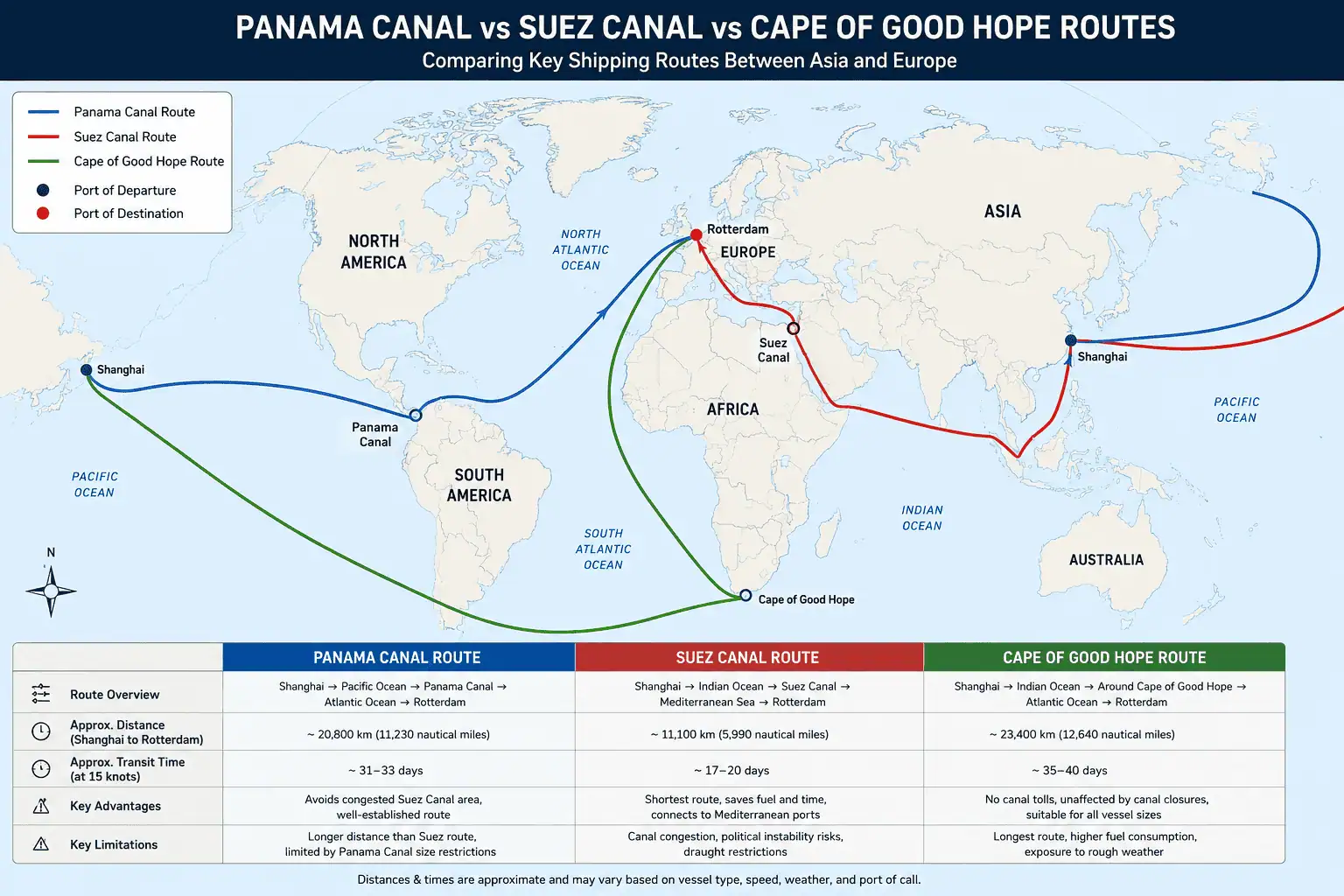
Panama Canal vs. Suez Canal as Alternative Routes
When Panama Canal challenges pushed costs and delays up, many carriers considered — and used — the Suez Canal or the Cape of Good Hope as alternatives. But this trade-off isn’t simple, especially since Suez has faced its own disruptions from Red Sea security incidents.
Pros of rerouting away from Panama:
- Avoids draft and transit-count restrictions
- Can avoid premium auction booking fees
- Sometimes cheaper during acute Panama congestion
Cons of rerouting away from Panama:
- Suez Canal has faced its own security-related disruptions in the Red Sea
- Cape of Good Hope route adds significant transit time (often 10+ extra days)
- Higher fuel consumption over the longer route
- Doesn’t help vessels specifically trying to reach U.S. East Coast ports from Asia
There’s no permanently “safe” route right now — which is exactly why many shipping and logistics leaders describe today’s environment as one of managing multiple simultaneous chokepoint risks rather than picking one reliable path.
What the Panama Canal Authority Is Doing About It
The ACP isn’t just reacting — it’s investing heavily to reduce future water risk. In late 2025, the authority detailed an $8.5 billion, decade-long modernization plan with three main pillars:
- New port terminals (Corozal on the Pacific, Telfers on the Atlantic), expected to add roughly 5–6 million TEUs of annual handling capacity
- A liquefied petroleum gas pipeline (~76 km, an estimated $4 billion) to move fuel across the isthmus without using canal water at all
- The Rio Indio Reservoir project (estimated at $1.2–1.6 billion), designed to secure freshwater supply for the canal and for roughly half of Panama’s population, with completion targeted around 2031
Short-term, the ACP has also been managing water more actively through cross-filling between lock chambers and optimized scheduling to reduce water use per transit.
Expert tip: The Rio Indio reservoir won’t be finished until around 2031. That means the canal is likely to keep making incremental draft adjustments in response to rainfall for at least the next several dry seasons. Build that into multi-year contracts and routing strategy, not just this year’s plan.
Common Mistakes Shippers Make With Panama Canal Planning
- Assuming “recovered” means “risk-free.” The canal returned to full draft in 2025, but tightened restrictions again in 2026 as new El Niño risk emerged. Treat water levels as a recurring variable.
- Booking without a contingency route. Shippers with no backup plan pay the highest premiums when slots tighten suddenly.
- Ignoring vessel type exposure. LNG and VLGC shipments are disproportionately affected by draft cuts — if you move these cargo types, your risk profile is different from a standard container shipper.
- Reacting only after delays hit. ACP typically announces draft and transit changes with some lead time. Monitoring ACP advisories directly is more useful than waiting for freight forwarder updates.
FAQs About Panama Canal Challenges
Is the Panama Canal still experiencing a drought in 2026?
Water levels recovered to full capacity in 2025, but the ACP tightened draft restrictions again in mid-2026 due to a forecasted El Niño pattern that could bring below-average rainfall. It’s an evolving situation rather than a resolved one — check current ACP advisories for the latest figures.
How much does the Panama Canal drought affect shipping costs?
During the 2023–2024 drought, some carriers paid well over $1 million in premium auction fees to secure priority transit slots, on top of standard congestion surcharges and rerouting fuel costs. Costs scale with how severe the restrictions are at any given time.
Why does the Panama Canal need freshwater to operate?
The canal uses a system of locks that raise and lower ships between sea level and Gatun Lake, roughly 85 feet above sea level. Each lock cycle uses millions of gallons of fresh water drawn from the lake, which then flows out to the ocean rather than being recycled.
What’s the difference between Panama Canal and Suez Canal challenges?
The Panama Canal’s main constraint is freshwater availability and drought. The Suez Canal doesn’t have this issue since it’s a sea-level canal, but it has faced security-related disruptions in the Red Sea. Both routes carry different, non-overlapping risks.
How many ships pass through the Panama Canal per day?
Normal operations allow roughly 36–38 transits per day. During the worst of the 2023–2024 drought, this fell to as low as 18 per day. As of 2026, transit counts vary based on ongoing draft management tied to seasonal water levels.
Will the Panama Canal’s new reservoir fix the water shortage problem?
The Rio Indio Reservoir project, targeted for completion around 2031, is designed to significantly improve long-term water security. It won’t eliminate short-term risk from a bad rainy season before then, but it’s the ACP’s primary long-term solution.
Conclusion: Key Takeaways for Shippers and Supply Chain Teams
Panama Canal challenges aren’t a one-time crisis story from 2023 — they’re a structural risk that shippers need to plan around every year. Here’s what to do with that:
- Monitor ACP advisories directly rather than relying solely on secondhand freight forwarder updates, since draft and transit changes are usually announced with some lead time.
- Build routing flexibility into contracts, especially for high-draft or LNG/VLGC cargo that’s most exposed to restrictions.
- Diversify port strategy between East/Gulf Coast and West Coast gateways so a single canal disruption doesn’t stall your entire network.
- Factor seasonal water risk into annual budgeting, the same way you’d plan around hurricane season or Lunar New Year factory shutdowns.
- Track the Rio Indio Reservoir and modernization timeline (targeted 2031) as the long-term marker for when canal water risk should meaningfully ease.
The canal isn’t going away, and neither is its exposure to rainfall. Shippers who treat that as a known, manageable variable — rather than a surprise every time it happens — will consistently outperform those who don’t.